Monday, September 3, 2007

16 June: Underground Rome

We were up at 7:30 and out the door by 9:30 to make sure we arrived on time at our Context: Rome tour meeting point near the Spanish Steps. (We never actually got to the Spanish Steps on this trip, but since the frenetic Piazza di Spagna area with its high-end designer boutiques and throngs of tourists is perhaps my least-favorite area of Rome, we were not overly disappointed.) Before leaving the hotel I made arrangements for our transportation back to the airport tomorrow afternoon. I think this was the sixth staff member I had spoken to at Residenza Canali and her English was not as strong as the rest, so I was a little nervous about whether we had communicated our departure time adequately. We decided to confirm again when we returned in the evening, just to be on the safe side.

I had surprised Mom with tickets for Context: Rome’s “Underground Rome: The Hidden City” tour for her birthday. I have never booked a tour for anything in my life, so I did this with some trepidation, but I read great reviews of Context: Rome and I was really hoping that we would get to see some unusual places that the ordinary tourist wouldn’t normally happen upon. Originally I was planning to book the "Layers of Rome" tour that included the Domus Aurea, Nero’s palace, but unfortunately this site has been closed to the public once again and the tour was taken off of Context’s schedule a couple of months ago. Thus I booked “The Hidden City” instead, which sounded interesting – including a visit to an ancient Roman apartment building.

We arrived at the meeting point in front of the church of San Lorenzo in Lucina about ten minutes early. Our guide, Elizabeth, an Austrian expert in Classical history married to an Italian man, arrived a few minutes later. We found her to be friendly and well-informed, and she spoke the most wonderful Austrian-and-Italian-accented English. We were joined by another mother-daughter duo and a mother and her teenage son, Jake (whom I liked immediately because he used his keychain flashlight to look into every nook and cranny). One of the things I like about Context is that they limit their groups to six people, so you don’t feel like you are part of some obnoxious horde following a guide yelling at the top of their lungs (or worse, using a loudspeaker) just to be heard.

With our group assembled, we entered San Lorenzo in Lucina, walked to the back of the church, down a corridor to a room displaying pottery and glass artifacts found at the site, and paid a 2 Euro donation to gain entry to the extensive ruins beneath the church. We entered via a short flight of stairs leading through a stone archway and found ourselves in a veritable maze of rooms. First we looked down into a dug-out pit where we could see the painted wall tiles from a 2nd-century building. Nearby, two rooms had been excavated to reveal extensive black-and-white mosaic tile floors (see photo). Several long corridors connected a series of rooms that had once constituted a 4th-century apartment building. We also visited a large domed room that was the site of the original 5th-century basilica, complete with a stone foundation where the ceremonial bath had stood. Elizabeth pointed out where columns and chunks of stone had been reused to make the foundation of the modern church. Jake used his flashlight to peer through a chink in the wall into an unexcavated room full of rubble (we joked that it looked to contain “ancient Roman trash”). There were signs of ongoing archaeological work everywhere – tags hanging off stones in the walls, crates crammed with ceramic shards – but Elizabeth told us that many Roman excavation projects are plagued by lack of funds, so the work usually happens in fits and starts, with long gaps in between.

Back outside, Elizabeth used a map to show us that we were standing on what used to be the broad plain of the Campus Martius, where the ancient Romans grazed cattle and carried out military drills. Elizabeth pointed out the original location of the Ara Pacis, the Arch of Peace, built by Augustus to commemorate his victories in Gaul and Hispania (John and I visited the reconstructed, intricately carved marble arch in its new, modern museum back in December) and, nearby, the spot where a towering Egyptian obelisk once stood. August had the obelisk erected as the focal point of a massive sundial; each year on his birthday, September 23rd (the fall equinox), the shadow of the obelisk would cut directly through the Ara Pacis, demonstrating that Augustus was clearly destined to be the bringer of peace to Rome. The obelisk was rediscovered after many centuries and now stands in front of the Palazzo Montecitorio, the seat of the Italian Chamber of Deputies.

Near the Pantheon we stopped to look at the crumbling remains of an immense, curved brick wall that was once part of the Baths of Agrippa. Over the centuries, houses have been built over, around, and literally through this ancient structure. I assume the interior rooms of those houses have curious curving walls, following the lines of the original building, although the brick has probably long since been plastered over.

Our next stop was the Crypta Balbi museum, which opened in 2000 as the newest addition to the National Museum of Rome. The site was discovered during construction work in 1981 and the new museum houses the remains of a crypta, an enclosed portico and large rectangular courtyard, which stood behind the stage of the Theater of Lucius Cornelius Balbus (one of Augustus’ generals). It was the smallest of three theaters in the vicinity, the others being the Theater of Pompey and the Theater of Marcellus. In Augustus’ time, the crypta was a place to relax and socialize during intermissions and between theater productions. Over the centuries, the theater and adjoining crypta fell into ruin, to be replaced by markets, warehouses, churches, homes, shops, and factories. Today it is very difficult to visualize the scale of the ancient Roman structures, but the museum does an excellent job of bringing the past to life through a series of schematics that show the theater in its heyday, and then how the site likely decayed and evolved over the ensuing centuries.

We had an 11:45 appointment to descend underground into the vast ruins beneath the modern museum. Elizabeth first showed us a section of exposed wall in which you can see fragments of the orginal marble-faced portico topped by centuries of medieval construction, including bits of Renaissance-era clay drain pipes – in all, more than twenty centuries of Roman history written in the stones. As we continued deeper underground, we passed through various chambers cluttered with chunks of columns and even the cobbles of an ancient Roman road.

At noon we had the unique opportunity to visit an active archaeological site hidden behind the museum. Elizabeth explained that we were lucky to be in the right place at the right time, as this was not part of the normal tour. We exited the museum via a back door and stepped out into an open area surrounded on all sides by a jumble of houses and the curious cantilevered tower of Santa Caterina dei Funari. We traversed the site on a covered metal walkway, peering down into various excavation pits, and descended a flight of stairs to enter the exedra, a large half-moon shaped, domed structure that stood at the opposite end of the portico from the theater (see photo, right). This particular structure was later turned into a public bathhouse, and a few sections of the curved bank of toilets have been reconstructed. We descended further into the rooms of an ancient villa, complete with marble and mosaic tile floors and a few surviving columns. At the end of a stone passage we found a temple to Mithras, an early-Christian era religious cult. The experience was spell-binding and, while the whole tour was worthwhile, this “behind the scenes” visit was the icing on the cake!

We left the Crypta Balbi and walked across the street to Largo di Torre Argentina, where Elizabeth explained the context of the four Republican-era temples and pointed out the area where Julius Caesar is believed to have been assassinated (outside the Theater of Pompey, the ruins of which are under buildings across the street). Mussolini had the Argentina ruins preserved, the story goes, because he wanted to emulate Augustus as the new “bringer of peace” to Rome.

At this point our tour came to an end. We thanked Elizabeth profusely, then Mom and I went across the street to a large bookstore that Elizabeth had recommended, where we each bought a copy of a book on ancient Roman monuments with reconstruction overlays (bigger and better than the small one I had purchased at the Colosseum).

It was now about 1:00 and we decided to wander back through the Jewish Ghetto (photo, right), where we had lunch at Da Giggetto, right next to the Porto d’Ottavia. We ate outside under an umbrella and had a fabulous meal despite the fact that it was oppressively hot and breezeless. We shared a half-liter of white wine and a simple caprese salad – a huge ball of mozzarella and juicy slices of tomato, just about perfect with a drizzle of olive oil and a dusting of black pepper. I had the house special cannelloni (spicy pork filling, delicious tomato sauce and rich béchamel) and Mom had the classic spaghetti alla carbonara (raw egg, pancetta, and parmesan); both were excellent. Our waiter was very friendly and funny – he seemed to know exactly what we were going to order before we ordered it, and when I asked him to take a picture of us with Mom’s camera, he turned it around and snapped a picture of himself first!

After lunch we crossed the Ponte Fabricio for the second time (beautifully framed by green leaves in the afternoon sun) back to Tiber Island, where we stopped for a few minutes to watch a group of Italians arriving for a wedding at the church of San Bartolomeo all’Isola. It was a scene straight out of a movie – the women dressed to the nines in chic black or navy with strappy stiletto-heeled sandals, the men in black suits driving expensive Italian and German sedans, and the children in frilly white dresses and patent-leather shoes.

We meandered our way back to Trastevere, which was tranquil and quiet, apparently enjoying an afternoon siesta. We stopped to take pictures of a particularly lovely tangerine-colored villa (right), whereupon not one but two older gentlemen stopped to smile and jabber at us in Italian. We had no idea what they were saying but they seemed to be pleased that we were taking a picture of this particular building. We smiled back and I took a picture of the plaque mounted on the building to try to translate later, assuming it meant something important happened there. (Postscript: Well, the plaque just seems to prohibit the throwing of something – rubbish? – in the street, so this little mystery remains unsolved!)

A little further down the street, two young men came around the corner carrying those huge super-soaker squirt guns that kids like to play with on hot summer days. We immediately held our arms out and I shouted, “Prego!” whereupon the men grinned and cheerfully obliged by spraying us with water.

We found the bead shop that we had visited on Friday; Mom had told the proprietor that we would come back but I’m sure he didn’t believe us. Mom bought some flower beads that she was coveting and I found some things I needed to finish my necklaces. The nice man gave me some crimp beads for free (carefully laying them on a bit of tape so I wouldn't lose them) and asked me about my photography (since I had my Canon digital SLR around my neck). On our way back we stopped for gelato in Piazza di Santa Maria in Trastevere because we realized that we had been in Rome for three sweltering days without a single gelato! I had coffee and dark chocolate and Mom had lemon and sour cherry. We sat at a table inside (the outside tables were full and it was refreshingly cool inside) and watched as yet another wedding party came tumbling out of the church across the square; half of the guests then seemed to descend on our gelateria! Best of all, we were served real ice water with our gelato and got to use the restroom.

We retraced our steps back to Tiber Island and the Ghetto and arrived back at our hotel with an entire hour to clean up before our dinner reservation at Il Bacaro. I dressed up for the occasion in my recently purchased black-and-white cotton sundress (all the rage in Rome). We were the first guests to be seated outside under the lovely vine-covered arbor. We perused the refreshingly innovative menu and ordered an excellent Pinot Grigio riserva. Mom had smoked goose carpaccio with paper-thin slices of white peach drizzled with olive oil, followed by veal cutlets with an incredible pink grapefruit sauce, and pistachio ice cream with strawberry sauce for dessert. We decided hers was the prize-winning meal of the whole trip – everything was perfectly fresh, gorgeous, and delicious. My meal started out on a bright note with a warm calamari salad with delicate lemon-mint pesto. I thought I would be healthy and ordered the swordfish roulades with shrimp, zucchini and radicchio in a soy-balsamic glaze, but the fish was downright fishy and too salty. I came very close to complaining, but for whatever reason decided to grin and bear it. My dessert redeemed my entrée (what was that about being healthy?) – rich chocolate mousse with even richer chocolate sauce, which was absolutely heavenly! Our three-course meal, including a 25 Euro bottle of wine, came to a very reasonable 100 Euro. Despite my disappointing entrée, I would highly recommend this place.

We thought we might actually get back to our hotel a little early for once (it was about 9:30) but we ended up delving into a lengthy conversation with the couple sitting next to us – an Irish woman and French man. We traded stories about Rome and our other travel experiences for a good half-hour before finally tearing ourselves away. I dragged Mom to the Trevi Fountain, which was of course totally mobbed with tourists from across the globe. We took some pictures and tossed a 1 Euro coin into the fountain together (assuring our return to the Eternal City) and then walked slowly back to the hotel, savoring every moment of our last night in Rome.

Sunday, September 2, 2007

15 June: Two Girls Loose in Ancient Rome

We got off to a slow start after our late night out on the town, but hey, this is our vacation and we get to decide when to get going in the morning! Ancient Rome was on the day’s agenda, but once again we got a little sidetracked not five minutes from our hotel – this time by the artists in Piazza Navona. We were particularly attracted to a display of large-scale landscape paintings, the work of a charismatic beret-wearing gentleman by the name of Paolo who immediately engaged us in conversation and, well, to be honest, charmed the living daylights out of us. He asked where we were from, and once he heard I was living in Stuttgart, he told me his father and his wife were both German, and that he had some of his paintings on exhibit in a gallery in Speyer. We joked about last year’s famous Italy-Germany World Cup football game and, since I told him we were in Germany for John’s job, discussed the pros and cons of German and Italian automobiles. Meanwhile we were continuing to peruse Paolo’s lovely paintings of the Italian countryside. I would have bought one but John and I like to purchase our artwork together. Mom became enamoured with a Tuscan vineyard scene and eventually decided to buy it (Paolo knocked the price down from 250 to 150 Euro, which, for a large oil painting, seemed like a reasonable deal). We walked to a nearby ATM to withdraw the necessary cash, at which point Mom admitted that she thought Paolo might be fooling us with the whole German story, but I heard him mutter in German when he was flipping through his paintings and I found it hard to believe that he had made the whole thing up on the spot.

After completing our purchase and taking pictures with Paolo, we returned to our hotel to deposit the painting (thanking our lucky stars once again for the convenience of our location), then continued on our slow journey towards the Roman Forum. We stopped at Piazza della Rotonda again so Mom could visit the Pantheon. Half of it was closed off at Christmastime, but it was now all opened up inside, so I was able to get some better photographs of the interior. We stopped at the tomb of Raphael and marveled at the sheer massiveness of the dome and original bronze doors.

We continued on down Via del Corso to Piazza Venezia and the great “wedding cake” monument to Victor Emmanuel, which was now mostly covered up with unsightly scaffolding. We wanted to tour Trajan’s Markets but discovered that they had closed at 1:00, a mere ten minutes before we arrived. We had to make do with the view of the ancient markets from the street above, then walked slowly down Via dei Fori Imperiali past the Forum of Augustus to the entrance to the Roman Forum itself. I had printed off a lengthy walking tour from the Fodor’s internet forum and we used it and my DK Eyewitness guidebook as we joined the throngs of tourists moving slowly through the ruins. I won’t go into detail here about the history of the many structures in the Forum, since I covered all of that in my journal back in December, but suffice it to say that it was as captivating as ever, despite the unrelenting heat. We enjoyed seeing the poppies and other wildflowers blooming amidst the ruins (a new experience for me since my two previous visits were in wintertime). A team of archaeologists was working on a dig in the heart of the Forum – the first time I have ever seen active work going on there – and we felt sorry for them having to slave away in the miserable heat.

Mom took a rest on a chunk of marble column near the Arch of Titus while I went to buy our tickets to the Palatine Hill and Colosseum, then we decided we had better grab lunch somewhere before continuing our tour. The place near the Forum recommended in Mom’s cookbook was closed, so out of desperation we ended up spending a small fortune at a place right across from the Forum (two unexciting salads of mixed greens, tomatoes, ham, mozzarella, and canned black olives, two Diet Cokes and a bottle of water set us back 43 Euro).

Next we took a quick tour of the Colosseum, bypassing the long line with our pre-purchased tickets. I actually find this amazing structure most impressive from the outside, but I knew Mom would want to see the interior. I bought a small book at the bookshop that depicts all of the major ancient Roman monuments with clear plastic overlays showing what they looked like in their heyday. We then had exactly one hour to tour Palatine Hill before closing time; once again it was wonderful to wander amidst the ruins after most of the crowds had left for the day.

I am always surprised by how few people make the short hike up to the Palatine – not only do you get the most spectacular view of the Roman Forum from the heights, but the ruins of the palaces of Augustus and Septimius Severus are absolutely mind-boggling. We asked a group of young Italians to take our picture looking out over the Forum and then made our way to the other side of the hill to see the palace ruins and look down on the green lawn of the great Circo Massimo. We were still admiring the sunken stadium next to Domus Augustana when we first spotted the guards shooing people towards the exit. (This was total déjà vu for me because when I first visited Rome with my brother Erik nearly 15 years ago, we also got chased down by the guards!) Mom and I were quite annoyed because it was a full fifteen minutes before closing time, but the guards were watching us like hawks and started yelling at us when all we wanted was to take a few pictures of the stadium. A group of guards literally escorted us all the way to the exit while we gave them nasty looks; it was quite amusing! Sadly I didn’t get a chance to show Mom the very cool Cryptoporticus, the long tunnel built by Nero to connect his Domus Aurea with the Palatine palaces, but we managed to see most of the other major Palatine sites.

After exiting the Forum, we walked the full length of Circo Massimo (this has become a sort of ritual for me on my trips to Rome). Mom rested on a bench while I ran across to the opposite side to get an overview shot of Palatine Hill. Lots of people were out for an evening jog, following in the footsteps of countless ancient athletes. A photo shoot was taking place in the middle of the stadium; a guy dressed as a chef was balancing an enormous stack of plates in one hand and we watched for a while to see if he would drop them (he didn’t). We continued down the quiet streets of the Aventine district, drinking from yet another public fountain, passing the four-sided Arch of Janus and the once-bombed church of San Giorgio in Velabro, then heading towards Capitoline Hill. We stopped briefly to admire the view down into the Forum – now closed for the night and completely empty and silent. At some point along the way my camera battery died and I discovered that the spare battery I had brought with me was not charged either, but fortunately we had Mom’s camera as backup.

The eye-catching geometric paving of Michelangelo’s Piazza del Campidoglio on Capitoline Hill was also nearly devoid of visitors; we were lucky enough to arrive just as the sun was peeking through the clouds to the west, lighting up the sky and the façades of the Capitoline palaces in shades of peach and tangerine. The sun gleamed off of the bronze equestrian statue of Marcus Aurelius as we drank in the whole scene. We strolled down the Cordonata, the great staircase leading from the Capitoline back to Piazza Venezia, whereupon I decided to run (literally) up the Aracoeli Staircase to see if I could get a view of the sunset. My efforts were not wasted; I joined one other lone photographer in front of the simple brick façade of the church of Santa Maria in Aracoeli to capture some incredible images looking out across the great domes of Rome. In the meantime Mom waited at the base of the staircase, befriending a young British couple who were hopelessly lost (they thought they were at the Spanish Steps). I showed them where they were on their map and what they should see in their limited time in Rome before we parted ways.

We stopped again at the base of the Victor Emmanuel monument to look at the ruins of some Roman apartment buildings before making our way back towards Piazza Navona. We decided to have dinner at Vecchia Locando, one of my favorite restaurants from our December trip. This time we ate outside (although their cellar dining room is awesome) beneath the atmospheric glow of red-bulbed lamps – a gorgeous setting on a narrow alley with a stone archway in the distance and blooming bouganvilla dripping down the wall above us. Amazingly, the same friendly waiter served us as in December and he thought it was quite funny that I recognized him. Sadly, Mom’s meal did not live up to expectations: she had a rather bland shrimp and artichoke pasta followed by steak with a radicchio and gorgonzola sauce. I talked her into the steak dish because I remembered an amazing sauce of the same description had topped my gnocchi back in December, but this time it was very bitter and almost tasted like they had forgotten to add the gorgonzola. We almost complained about it but decided not to. Fortunately Mom’s tiramisu was awesome. My meal, on the other hand, was fantastic – radicchio ravioli with gorgonzola followed by carpaccio with arugula, mushrooms, and parmesan (I think I could eat this meal every day for the rest of my life). For dessert I had the “chocolate pyramid” – a delectable concotion of chocolate mint with a hidden “treasure” of crunchy candied paste inside, all smothered in dark chocolate mint sauce. (This dessert was on the menu in December but they had run out; I was really happy to have another opportunity to sample it!) We finally made it back to our hotel after another stroll through Piazza Navona and turned in, thoroughly exhausted, at midnight. We had been on the streets of Rome for nearly fourteen hours!

Thursday, August 30, 2007

14 June: The Many Faces of Rome

We enjoyed a nice breakfast in Residenza Canali’s bright and cheerful dining room: a traditional buffet of sliced meat and cheese, croissants, fruit tart and several other pastries, cereal, yogurt, fresh fruit, juice, coffee and tea. It was above par for a European breakfast and I’ve decided that the Residenza Canali is a real find – quiet, charming, and a good value given its perfect location right next to Piazza Navona. (Our room was listed at 205 Euro but we saved 20 Euro per night by paying cash.)
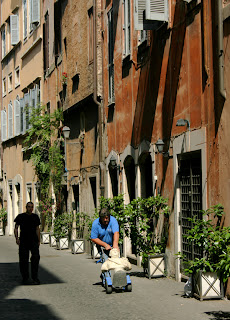
One of the reasons I chose Residenza Canali was its location just off of Via dei Coronari, which I discovered – and fell in love with – on my last trip to Rome. This narrow cobblestoned street is lined with countless antique shops, art galleries, jewelry stores, and artisans’ workshops. On any given day you can peek in an open doorway and see someone restoring an ornate carpet or mending a Renaissance armchair – or even watch a man rolling an ancient marble bust down the street on a trolley, as we did (photo, right). Only local traffic is allowed, so aside from the occasional screaming scooter, it is a peaceful place to wander and window-shop. Mom and I set off around 10 a.m. with the intention of making our way down Via dei Coronari towards the Vatican, but we were immediately waylaid by a tiny jewelry shop that tempted us with a wide selection of Murano glass beads. We ended up browsing for over an hour; I came out with enough beads to make two necklaces and two pairs of earrings for a whopping 25 Euro. I think Mom and I both began to realize at this point that there are some serious advantages to traveling without our husbands…

We finally tore ourselves away from the beads and baubles and made our way down to the Tiber River, passing under the blind gaze of the angels lining the lovely Ponte Sant’ Angelo. We strolled past the street artists hawking their wares in front of Castel Sant’ Angelo and then headed down Via de Conciliazione to Piazza San Pietro. The line to get through security and into St. Peter’s Basilica was actually shorter than it had been at Christmastime and moved quickly. I had heard many stories about the summertime “clothes police”, who are on the lookout for women with bared shoulders or showing too much leg. Sure enough, there were two young men dressed all in black (poor dears, they must have been sweltering) who were picking women out of line and sending them away if they couldn’t come up with a shirt or sweater to cover their shoulders.

Mom and I were, of course, appropriately attired and followed the throngs into the welcoming coolness of St. Peter’s. We spent a long time admiring the vast interior and spectacular works of art, including Michelangelo’s Pieta. We decided to go into the crypt beneath St. Peter’s, since I had never been inside and figured I might regret it if I missed this opportunity. En route to the crypt, we drank from a fountain in the courtyard – holy water or not, it was certainly cold and refreshing! I love the fact that Rome is full of fountains offering a free drink when you need it. In the crypt we saw the tombs of countless popes, including that of John Paul II, where many visitors were stopping to pay their respects.

Back outside, we stopped in the piazza for more pictures (a nice American woman offered to take ours) and then made our way along the Tiber towards Trastevere. This was a long walk in the heat but fortunately we could keep to the shade of the trees lining the river. We took a dead-end street by accident and asked a couple of American kids (who looked to be college students) for directions. We quickly discovered why so many people love this neighborhood – Trastevere is a bit off the beaten track, but it gives you a glimpse of the “real Rome” that most tourists never see. We left the busy summer crowds far behind and got lost for a while on the narrow cobblestone streets, lined with scooters and framed by laundry drying on lines strung high between the houses (photo, right). We stopped at a jewelry store, whose young proprietor (actually the owner’s son), kept up a charming but insistent sales pitch. We found out he was a former judo champion and his sister owns an antique store on Via dei Coronari. I ended up buying a moonstone pendant from him, then we visited another bead shop but decided to hold off on any further purchases as we were anxious to find a good spot to have lunch.

We found our way to Piazza di Santa Maria in Trastevere, dominated by the tall, square bell tower of Trastevere’s most famous church. We wanted to have lunch before we visited the church, as it was getting on in the afternoon. The piazza was gorgeous and relatively quiet, but none of the cafés looked appealing to us. We went in search of a restaurant called Lucia, which was recommended in one of Mom’s Italian cookbooks, but when we finally found it (with the help of a young man whom we stopped for directions), we discovered that it was already closed for the afternoon. A man standing outside the restaurant saw us peering in the window, so we asked him for another suggestion. He pointed us back towards Piazza della Scala, which we had walked through already, and we ended up eating at a lovely little place called Taverna della Scala (photo, right). We both had the ensalata mista (mixed greens, radicchio, corn, tomatoes, and olives with oil-and-vinegar dressing), shared a perfect pizza Cappriciosa (prosciutto, mushrooms, egg, olives), and drank down two entire bottles of mineral water and a half-caraf of white wine.

We lingered as long as we could under our umbrella, looking out at the charming little piazza, but it was so hot just sitting still that we had to get moving again. We retraced our steps to visit Santa Maria in Trastevere, which is considered the first official Christian place of worship in Rome, founded in the 3rd century. The church you see today dates mostly from the 12th century and boasts the most unbelievable mosaics by Pietro Cavallini, as well as twenty-two granite columns taken from the ruins of ancient Roman buildings. You can put a few coins in a machine to light up the mosaics for several minutes, but no one could make it work. An elderly gentleman sitting in a pew a few feet away said something to me in Italian, and I slowly realized that he was telling me to put in 50 cents (the sign on the machine was confusing, as it made it look like you could put in less money for less time). I dropped in the correct coins and suddenly the entire nave was bathed in golden light, reflecting spectacularly off the gold mosaic tiles (photo, right).

By now it was getting on towards evening, so we headed back to the river and crossed over the ancient Ponte Cestio to Tiber Island. Once the site of a temple to Aesculapius, the god of healing, the island has always been associated with the sick and is still home to a hospital, along with several old mills and the 10th-century church of San Bartolomeo all’Isola. As we approached the island we spotted the single remaining arch of the Ponte Rotto (“broken bridge”), which dates from the 2nd century B.C. and now stands forelornly in the middle of the river. We crossed the Tiber on the other side of the island via the graceful triple-arched Ponte Fabricio, the oldest Tiber bridge still in use (for foot traffic only), built in 62 B.C. (photo, right).

We stumbled on the Jewish Ghetto pretty much by accident, as we spotted the imposing Synagogue, constructed in 1904, looming across the street. There has been a Jewish community in Rome since the 2nd century B.C.; their persecution began in the year 1556, when all of Rome’s Jews were crammed inside a highly unsanitary, walled-in neighborhood that came to be known as the Ghetto. The practice of driving the Ghetto’s Jews to the nearby church of Sant’ Angelo in Pescheria to listen to Christian sermons was not abolished until 1848. Thousands of the Ghetto’s inhabitants were rounded up and deported to concentration camps during World War II. Many Jews still live in the Ghetto today, and it is now a pleasant neighborhood of quiet alleys, secluded piazzas, small shops, and family-run restaurants, not to mention several of Rome’s most impressive, but lesser-known, ancient monuments.

We found two of these monuments within a few minutes – the first being the Portico d’Ottavia, all that remains of the massive rectangular portico that once enclosed the temples of Jupiter and Juno. Built by Augustus in honor of his sister Ottavia, the portion that stands today is the grand central atrium, once faced with marble. The dome of Sant’ Angelo in Pescheria rises above and behind the portico; the church was built on the ruins of the temples. If you approach the portico from the Tiber, as we did, and turn right, you cannot miss the massive curved wall of the Teatro di Marcello, the Theater of Marcellus, also built by Augustus and dedicated to his beloved nephew and son-in-law (and hoped-for heir), who died in 23 B.C. at the age of 19. (These ruins were particularly significant to me as I was reading the new biography of Augustus by Anthony Everett, which I highly recommend.) All that is visible of the original amphitheater are two levels of imposing stone arches. Over the centuries countless buildings have been constructed within and on top of the ruins of the theater, including the 13th-century fortress of the Savelli family and the 16th-century Orsini palace, so the structure now displays an amazing patchwork of architectural history.

We walked around the theater ruins for a while and came across some workers setting up a stage and chairs for what looked to be a private concert, with the ancient arches of the theater as a backdrop. A young woman with long black hair was sitting in one of the chairs, watching the proceedings with great interest. When Mom and I stopped to watch a black grand piano being rolled out onto the stage, I saw the woman smile, but thought nothing of it at the time. A little while later, we made our way to a higher vantage point with the intention of taking some pictures of the theater. Imagine our surprise when the very same young woman took a seat at the piano and began to play. She was obviously warming up for a concert later that evening, and we stood there for a long time watching and listening as strains of Chopin floated up to us, echoing off the imposing arches, the whole scene bathed in an ethereal golden light. We felt incredibly lucky to have happened upon that spot at the right time to witness such a special treat. I would give anything to know the pianist's name (and what piece she is playing)! (Watch and listen below.)

We wandered through the quiet streets of the Ghetto, stopping to peek into a gorgeous courtyard at what was clearly an important building, its stuccoed walls lined with sculptures and friezes. We made our way back to Campo de’ Fiori, lined with ancient, crooked houses – all glowing in the evening sun in shades of peach, pink, and yellow – and decided to eat dinner at La Carbonara. Unfortunately we ended up being disappointed with our meal. I had heard about the famous “Jewish-style” fried Roman artichokes called carciofi alla giudia and saw many people eating them on this trip, but we were not impressed; we found them very prickly and rather bland. Mom ordered a fried sampler platter, which she thought was going to include fried shrimp and calamari, but it ended up being only vegetables and what we later determined to be fried lamb’s brains! The taste we could live with, but the texture was, well, rather unappetizing. I had fried zucchini flowers with mozzarella and anchovies, another Roman specialty, but they were too thickly battered and not very flavorful. To top it all off, the service was slow and the waiters very brusque. Despite this disappointment, we enjoyed the people-watching while downing a full liter of the house white wine, which only set us back 8 Euro!

After dinner we walked back to Piazza Navona and watched the street performers. The same opera singer was still captivating his audience and we watched a lengthy magician’s show which, if I described it, would sound extremely silly, but we were laughing hysterically the whole time. Let’s just say you had to be there.

We went back to our room to wash up and unload our handbags, but despite the fact that we had been on our feet for 12 solid hours, we weren’t quite ready to call it a night yet. So, in a totally spontaneous girls'-night-out frame of mind, we decided to return to Piazza Navona for some drinks and entertainment. The piazza had quieted down a bit (it was 11:30 on a Thursday night, after all) but a group of guys that we had heard having a guitar jam session last night looked like they were getting ready to play another set, so we snatched front-row seats at the neighboring restaurant. I ordered a Bacardi cocktail and Mom got something with secco and Campari from the extravagant drink menu. The guys played rock ‘n roll classics, including “Hotel California” and “Sultans of Swing” (Dire Straits), which happens to be a favorite of John’s, so I filmed a short clip of them on my little digital camera (see below). When we asked for our bill I was dismayed to discover that it came to 21 Euro, including a 3 Euro cover charge, because we had left our wallets at the hotel and I had only brought a 20 Euro note! Now I was really grateful for just how close the Residenza Canali is to Piazza Navona, because I left Mom at our table and literally ran the 200 yards or so back to our hotel to get some more money. I think the guy at the front desk got a good laugh out of my antics as I raced up and down the stairs.

Suffice it to say that this was an incredible first day in Rome and, despite the heat, Mom was having a great time and I couldn't wait to show her more of my favorite city!

Here are short video clips of our private piano concert in front of the Theater of Marcellus and the late-night Piazza Navona jam session:


Wednesday, August 29, 2007

13 June: Tragedy Strikes as We Depart for Rome

I had seen very little of Frau Dörr over the past two weeks, but I did know that as of sometime last week, Endor had fallen mysteriously ill. Frau Dörr said he wasn’t eating and the last time John saw him, a day or two ago, he looked very thin and weak. At that time Frau Dörr told John that she was taking Endor to the vet for exploratory surgery the next day.

Mom and I were still packing right down to the wire this morning, so Endor was not at the top of my mind. I was taking Cody out in the final minutes before our departure when I spotted Frau Dörr working in the backyard. Cody ran up to her first and when I caught up, I realized that she was digging in the dirt with a shovel. My heart literally sank like a stone. She waved to the hole she was digging and said something about Endor, but I didn’t hear her. I said, “Er ist…?” not wanting to finish the sentence, hoping against hope that I had misunderstood. She nodded sadly and said, “Er ist tot.”

I am the kind of person who wears my emotions on my sleeve, and naturally I was devastated. Dear, sweet, Endor, the boxer with a face only a mother could love, was dead at the tender age of nine years – a good life, certainly, but all too short for a dog of his breed. I gave Frau Dörr a spontaneous hug (to hell with conservative Schwäbisch tradition) and called to Cody, who was dancing around as usual, no doubt looking for his buddy Endor in the garden below. Cody’s naïve cheerfulness only made things worse, and I couldn’t keep the tears back as I told Frau Dörr how terribly sorry I was (my German pretty much failed me at this point, but I think she understood). I literally had to tear myself away, as we were already running late.

I quickly called John and left him a message, telling him to hurry home and help Frau Dörr dig Endor’s grave if he could. By the time he got home from work, Endor was already buried. We later found out that he had died from liver failure, but he fell ill so suddenly that we have to wonder what exactly happened. We were afraid it might have been poisoned food, having recently heard about the massive pet food recall in the U.S., but we will never know for sure what ended Endor’s life so unexpectedly. I just cannot believe that he is gone. Cody has lost his favorite playmate, and the Dörrs have lost their much-adored companion. I was always planning to take some video of Cody and Endor playing in the backyard, but I never got around to it, so all I have are a couple of quick snapshots of Endor in his beloved garden. His was a sweet soul, and he will be missed.

Suffice it to say that this was not how I expected to begin our mother-daughter get-away to Rome. Mom and I arrived at the airport early enough to grab a bite to eat in a café and I just sat there in shock, munching on a dry sandwich. I had to make a very concerted effort to stop thinking about Endor because I was worried I might just cry my way through the whole trip. Fortunately we had other things to occupy us…Mom was traveling carryon and her bag turned out to be 2 kilos overweight (I didn’t realize that German Wings has an 8 kilo weight limit), but the man at the ticket counter was nice and let her take it on board anyway. We took a bus out to our small plane and our flight left promptly at 2:20 p.m.

After an easy 1 hour-20 minute flight over the Alps and down the western Mediterranean coast of Italy, we landed at Rome’s Fiumicino airport. As we deplaned the flight attendants handed us cold drinks; I understood why when we stepped out into to the stagnant heat of a midsummer day in Rome. We had a rather long wait for my suitcase (during which time Mom espoused the advantages of traveling carryon), then found our driver Luca waiting for us with my name on a sign, just like last time (once again I had arranged for transportation through our hotel, which cost 45 Euro plus tip). Luca was very friendly and navigated his little minivan quickly – but not terrifyingly quickly – through the streets of Rome, taking the same route as in December, so I was able to point out some of the major sites to Mom en route.

I had booked us a twin room at Residenza Canali, located on Via dei tre Archi near Piazza Navona. The street is in fact a tiny alleyway, too narrow for even a single car, so Luca parked as close as he could get, grabbed our bags out of the back, and escorted us down the street. We didn’t find the hotel immediately, so Luca asked for the number again. I pulled our reservation out of my bag and confirmed the address. We walked the entire length of the street, which turns at a right angle at one end around a tall palazzo the exact shade of a weathered terra cotta flower pot, before finally discovering the unassuming entrance to number 13. It was a tall, dual-paneled wooden door in the aforementioned terra cotta palazzo, with a tiny white label next to the doorbell that read RESIDENZA CANALI in block print. Luca rang the bell, the lock clicked, and we let ourselves in. We found ourselves in a tiny entryway and the only way to go was up – a curving flight of stairs with an arched ceiling painted the color of a ripe apricot. We found the reception area on the second floor and Luca left us in the hands of the nice young man at the desk. I had read a few negative reviews about the service at Residenza Canali, especially with regard to female guests, so I was on the lookout for anything amiss. The only problem with our check-in was that the man did not offer to carry Mom’s bag, which she had to lug up two more flights of stairs to our room on the fourth floor (there is one more floor above ours with two rooms that have private rooftop balconies).

Our room was European in scale – which means small – with two of the narrowest twin beds I’ve ever seen, and about six inches of space between them. But we had a nice roomy wardrobe with space for our bags inside, a dressing table, and a small but very clean aqua-and-white tiled bathroom. There was only one overhead light in the bedroom, which made it a little dim, and a tall window with heavy green curtains. We realized that the outer shutters were closed and by opening these we could let a little more light in. Our view over the alley to the neighboring tangarine-orange house was not anything like the Albergo del Senato of course, but it was charming and quiet. The bathroom also had a shuttered window, so we had plenty of fresh air. Best of all, our room had an air conditioner, for which we ended up being quite grateful! I have to say I was a tad disappointed at the smallness of the room, based upon the photos on their website, but given how little time we ended up spending there, it really was not a problem.

We cleaned up and set out to explore our neighborhood. It was about 7 p.m. by this time and the sun had dropped low enough to give us some relief from the heat. We discovered that we were literally a stone’s throw from Piazza Navona (and I can’t throw a stone very far). Sadly, Bernini’s Four Rivers fountain in the middle of the piazza was still covered up for restoration; I guess they don’t do anything very quickly in Rome. We made a big circle of the piazza, which was full of happy tourists enjoying their dinners al fresco. Street performers were everywhere, including a handsome opera singer who had Mom totally fooled – she thought one of the restaurants was playing a famous recording!

We made our way to Il Bacaro, a restaurant recommended in my DK Eyewitness guidebook, which John and I had tried unsuccessfully to get into back in December. I had decided we should make a reservation for dinner there on our last night (a Saturday) so we wouldn’t get stuck without a nice place to eat. We continued on to Piazza della Rotunda and viewed the Pantheon from the outside (it was closed for the night), then decided to try Fortunato al Pantheon for dinner (also listed in DK), just around the corner. We couldn’t get a seat outside but it was actually quite cool and quiet inside - a welcome respite from the craziness of a hot summer’s eve in Rome. Our dinner at Fortunato was just about perfect. Mom had gnocchi with gorgonzola sauce, followed by veal with lemon; I had spaghetti alla vongole (with clams) and an absolutely perfect (and quite generous) plate of carpaccio. We shared a bottle of Soave and while it wasn’t cheap (87 Euro), it was heavenly enough to be worth every cent!

We walked back to Piazza Navona via the Piazza della Rotunda again (I just can’t get enough of the Pantheon, and it is equally spectacular at night), where we stopped to watch a hilarious mime performing his heart out in front of the fountain. He kept following unsuspecting passersby as they walked across the square, mimicking their movements and acting surprised when they noticed him. One woman stopped to pose for a photo with him, and while her male companion snapped their picture, the mime picked up the woman and ran off with her! We ended up making another loop around Piazza Navona (which is apparently the place to be on a summer night in Rome) before returning to our hotel and literally collapsing into bed.

Tuesday, August 14, 2007

12 June: Mainau - A Garden Lover's Paradise

We took yesterday (Monday) off to recover from the weekend and do some housework, plus I had to finish a photo collage for the IWC fundraiser coming up this weekend. I promised Anne, the club president, nearly three months ago that I would make the collage (in my capacity as unofficial club photographer), but of course I procrastinated and only started working on it last week. I finally got some black posterboard from my friend Shannon (who got it on base - her husband is a military contractor) and printed out all the photos over the last few days, so on Monday I just had to glue all the pictures on the board, print out the captions, and finagle a sort of stand out of cardboard (also supplied by Shannon) so the boards would stand up. It took longer than expected (naturally) because I had to trim all the photos with an exacto knife, but I had to get it done today, as Anne is picking it up tomorrow morning and Mom and I are leaving for Rome tomorrow afternoon! I actually think it turned out quite nicely, in a 6th-grade science project sort of way. (What became quite obvious as I printed out the photos is that in 90% of our activities, we are eating! I guess you know where our priorities lie...)

With that task out of the way, we were ready for today's adventure. Mom is an avid gardener and I’ve been looking forward to taking her to the garden island of Mainau in the Bodensee (Lake Constance) ever since we began planning her visit several months ago. John, on the other hand, is not a big garden fan, so it made sense to make this trip on a weekday while he was at work and the crowds would hopefully be thinner. Originally I thought we would make the 90-minute drive to Meersburg on the north shore of the Bodensee and take the ferry from there to Mainau, but upon closer examination of the route I determined that it would take just about the same amount of time to drive straight to Mainau. This meant missing Meersburg, but our time was limited and our main goal was the gardens, so we decided to skip the ferry trip.

We made the pleasant drive in the SLK in just over an hour and a half, aided by a clear stretch of Autobahn where I was able to demonstrate for Mom what it feels like to drive 210 kph (130 mph). We didn’t have the benefit of a navi today, but once we approached the island, well-marked signs directed us to the visitor parking lot on the mainland (the island is connected to the mainland by a long causeway, pictured at right). We parked and walked along a shaded pathway, passed by the occasional cyclist, to the ticket kiosks (the entrance fee is 9,50 Euro per person), eyed the gift shop where plants apparently make popular souvenirs, and passed through the turnstiles. Mom noted that most of the visitors on this lovely Tuesday morning were of an “older generation”; a man watching the turnstiles gave us a big smile, probably recognizing our mother-daughter outing for what it was, and wished us a nice day.

We headed across the causeway under blue skies dotted with fluffy clouds, a vast expanse of aquamarine stretching away to rolling green hills on either side of us. Looking down through the crystal-clear water, we could see silver fish swimming above the sandy bottom. A variety of shorebirds were paddling in the shallow water and foraging in the reeds along the shoreline.

As we approach the island, allow me to share some of Mainau’s fascinating history with you. Evidence of human settlement here dates back to 3000 B.C.; Mainau became a Roman holding, then an Alemannic dukedom and later a Frankish royal property before being given to the powerful monastery of Reichenau in 724 A.D. The Reichenau presented the island to the Teutonic Order of Knights in 1272. The House of the Teutonic Order, originally located in Switzerland, was transferred to Mainau, and at this time the island’s existing castle was enlarged. The Teutonic Knights were defeated by the Swedes in the Thirty Years’ War of the mid-17th century, at which time the island fell under Swedish control for the first time. The Swedes withdrew from the island in 1649; one hundred years later, the Teutonic architect Johann Caspar Bagnato started work on a new church and castle, which were completed in 1746.

The Teutonic Order was dissolved in 1806 and the island went to the newly founded Grand Duchy of Baden. Prince Nikolaus von Esterházy purchased the island in 1827 and was the first to cultivate rare plants there. Grand Duke Friedrich I acquired Mainau in 1853 and improved the arboretum, the Italian rose garden, and the orangery, bringing back many valuable trees and exotic plants from his travels, which form the basis of the gardens as we see them today. In 1856, Friedrich I married Princess Louise, daughter of the Emperor Willhelm I of Prussia, and the island was inherited by their son, Grand Duke Friedrich II, in 1907. Upon his death, he passed the island to his sister Viktoria, Queen of Sweden, who in turn left it to her son Prince Wilhelm of Sweden. Finally, in 1932, Prince Wilhelm handed over the administration of the island to his 23-year-old son, Prince Lennart, who made Mainau his new home, having renounced his title and possible succession to the Swedish throne by marrying a commoner. Prince Lennart was responsible for opening Mainau to the public. The island remains a possession of the Swedish royal family today; it is now operated as a foundation and has become one of the biggest tourist attractions of the Bodensee.

We soon reached the shaded borders of the island, where we were welcomed by a giant topiary-like sculpture of a flower in a flowerpot (2nd picture from top). (There were several of these fanciful creations scattered across the island – one in the form of a peacock, another a reclining gnome.) A meandering path led us first to the herb garden, where dozens of culinary and medicinal plants are cultivated in rings surrounding a whimsical rooster fountain. Our route took us along the south side of the island, past the petting zoo, which includes a special breed of tiny cattle, and on to the magnificent Rose Promenade (pictured above), where we enjoyed the spectacle of more than 800 varieties of rose, primarily wild and bush varieties, along with other gorgeous landscape flowers (see photo of Mom under a rose arbor, above). The hot weather in May had disrupted the normal blooming cycle, as many of the roses were already past their prime. (At the ticket kiosk we picked up forms to vote for the most beautiful rose and I noted that the selection is normally made in July, but they had obviously moved the contest up due to the unusually warm weather.) Along the Promenade, we found a spectacular rosebush in the height of bloom, a veritable symphony of tiny magenta-and white blossoms, fittingly called “Mozart,” which ended up being Mom’s favorite (photo, above). Higher up on the hill above the roses we could see grapevines and apple orchards; the weeds were being kept down between them by grazing goats.

Our next stop was the Italian Water Staircase, which features a stunning waterfall cascading down stone steps, flanked on either side by lush flower beds (photo, above). This year the entire island has been embellished with artwork by the artist Stefan Szczesny, and his colorful globe-shaped pots added a touch of whimsy to the postcard-perfect scene. From here we strolled through the fuschia garden, which has some spectacular ten-foot-high specimens, and stopped to take in the view of the Bodensee looking out towards Meersburg. Complete with a few palm trees, Szcesny’s exotic sculptures, and the intense blue-green waters of the lake scattered with crisp white sails, we felt like we had been transported to the Mediterranean (photo, above). I couldn’t help notice two elderly ladies sitting on a bench together, enjoying the view from the shade of a huge tree – they were both dressed from head to toe in shades of pink, from their airy sunhats to their handbags. We were about ready for a rest ourselves, so we took a short break to lounge in one of the curious wicker “cabana chairs” that I have seen before in pictures of northern German seaside resorts, complete with blue-and-white striped cushions, pull-out footrests, and folding drink trays (photo, right).

We were starting to get hungry as we rounded the east side of the island, so we climbed up a path to the palace – a creamy stuccoed building with red trim and white shutters, laid out in a U-shape alongside the Renaissance-style church (photo, right) – and looked for one of the restaurants labeled on our map. The café in the palace only serves sweets, so we went back outside and found the Schwedenschenke (Swedish Tavern), where we snagged one of the last tables on the shaded terrace. We both ordered mixed salads and the house drink, a tropical concoction mixed with sparkling wine (the waiter actually grinned when I ordered it).

After our energy boost, we were ready to take on the Italian rose garden on the south side of the palace (photo, right). (At this point my camera battery died and I discovered that the spare battery I had brought was not charged, so I had to commandeer Mom’s camera and used it for the rest of the day!) Planned in the 19th century on a strict geometric design, this vast rectangular garden is surrounded by a pergola of climbing roses and other creeping plants (photo, below) and features three circular fountains down its center. A curving grand staircase leads into the garden proper, which is laid out in long rectangles of lawn bordered by every variety of floribunda and polyantha rose under the sun. It was a feast for the eyes – rich swaths of red, pink, peach, yellow, cream, and white – and the nose, as the fragrance of thousands of blossoms wafted through the warm summer air. We spent a considerable amount of time strolling the gravel walkways, trying to decide which rose variety was the most beautiful. Past years’ winners took pride of place in the beds bordering the fountains (photo, right).

After dragging ourselves away from the roses, we found ourselves on the Mediterranean Terraces at the top of the Italian Water Staircase. There were very few people in this area and we lingered for a while, taking in the spectacular lake views and the display of fascinating tropical plants – birds of paradise, trumpet vines, passion flowers, agaves, palm trees, and bougainvilleas. In a secluded corner we came across a gorgeous fountain featuring a metal sculpture of two graceful swans standing in a shallow circular pool (photo, below). Mom just couldn’t resist the opportunity to take off her sandals and cool off her feet!

We headed back along the spine of the island, strolling along a pleasant tree-lined esplanade through the arboretum (photo, below), where some of Friedrich I’s specimens still thrive.Our last stop was the famous Schmetterlinghaus, Germany’s largest butterfly conservatory, where a winding path leads you through a tropical landscape full of hundreds of fluttering butterflies. A rushing stream, cascading waterfall, and misting water add to the tropical effect. Many of the butterflies stop to sample the nectar of the exotic blooms (photo below), but plates of fruit are also set out so you can see some of the insects up close. It was, not surprisingly, incredibly steamy in there, so we didn’t linger as long as we might have liked.

By this point we were way past our intended departure time so we had to skedaddle. We didn’t get to see everything – there is a frangrance garden near the butterfly house, a greenhouse off the palace, and various exhibitions in the visitor center – so I wouldn’t mind going back someday. (Apparently the gardens are spectacular in springtime when all the bulbs are in bloom.) We did stop at the gift shop to buy magnets and, on a whim, I bought an ornamental pomegranate plant for our balcony. Suffice it to say that Mainau more than exceeded our expectations – Mom said it was the most spectacular botanic garden she had seen in Europe. We couldn’t have asked for a more perfect day (except perhaps to turn down the heat a few notches!).