Showing posts with label Italy. Show all posts

Sunday, November 4, 2007

5 August: Switzerland's Finest

Morning dawned to reveal bright blue skies and a gorgeous view of Lake Como out our window – it doesn’t get much better than this! We wanted to take a stroll around town before checking out, so we were among the first guests down to breakfast in the Metropole’s lakefront dining room. We made our selections from the simple buffet and served ourselves from the coffee machine (not bad coffee, actually), then set out to explore. It was Sunday so the streets were very quiet. Bellagio is full of pretty cobblestoned streets that stair-step down the steep hill to the lake (photo, right). I couldn’t get enough of the warm-toned villas with their wrought-iron balconies overflowing with flowers and vines. We wandered into the piazza in front of the church just as everyone was arriving for services. We walked back along the waterfront, then went down the lovely floral promenade and enjoyed the view back to Bellagio (photo, right) and across the lake to Varenna.

After making a big loop around town, we returned to the hotel to check out. John waited with the luggage while I retrieved our car. We caught the 10:15 ferry to Cadenábbia, on the western shore of Lake Como. (I have to remark that the ferry system on Lake Como seemed highly efficient and using it was a breeze. It would be quite easy to spend a few days zipping around the lake without need for a car.) We were parked at the very front of the ferry and people were definitely eyeing our car (which I admit did look oh-so appropriate on the streets of Bellagio). We felt quite self-conscious – in a guilty-pleasure sort of way – as we got into the car and put the top down. I took the wheel to drive us out of Cadenábbia, past more gorgeous tile-roofed villas clinging miraculously to the steep slopes, with magnificent views out over the lake. We headed northwest on route 340, which winds along the north shore of Lake Lugano. It was a crystal-clear morning and the lakeside villages of Porlezza and Albogasio looked like especially nice places to spend a few relaxing days.

We soon crossed back into the Italian-speaking part of Switzerland and descended into Lugano, a large resort town nestled along the lake. It was too big for our liking, with lots of highrise apartment buildings, but we figured we could at least find a gas station here where we could buy a Swiss highway vignette – the toll sticker that you have to place on your windshield (similar to Austria’s system). Unfortunately, since it was Sunday, several of the gas stations we passed were closed. The first one we found that was open did not sell the vignettes, and we were starting to get a little desperate as we approached the autostrada. Finally, at the very last gas station before the autostrada entrance, we were able to buy the vignette, which set us back a whopping 40 Swiss francs (about $35). It’s valid for a year – too bad we would only be in Switzerland for three days!

We hooked up with the A2 and headed north, through Bellinzona. At Biasca we got off the A2 and continued north on the Strada del Lucomagno – a smooth, wide, two-lane road – which tooks us over the Passo del Lucomagno (#13, 1914 meters). On the ascent we wound up through a dramatic green valley flanked by steep wooded slopes dotted with slate-roofed cottages. At the top we passed a small reservoir held back by an enormous concrete dam, and then we traversed a long, broad, high-mountain meadow called the Val Medel. This area seems to be a very popular destination for Sunday picnickers, as they were out in full force, camped out on the sandy banks of the lovely river bisecting the valley.

At Disentis / Mustér we headed west on route 19, towards the Oberalppass (#14, 2044 meters) to Andermatt. This was an awesome stretch of road and I think John was beginning to regret his insistence on driving the Stelvio Pass, because I seemed to be getting the best roads. Unfortunately I was waylaid by some slow-moving traffic on the ascent of the Oberalp, but it wasn’t nearly as busy as Stelvio and I was able to pass a few cars on the straightaways. We stopped at the top of the Oberalp for lunch (photo, right; most of the passes are marked by a cluster of hotels and restaurants and we figured we should have the experience of eating at one of these places at least once). We had spent most of our Swiss francs already on the vignette and the restaurant didn’t take credit cards, but fortunately they accepted Euros. It was sunny and warm enough to sit outside on the terrace and enjoy the view, including the endless parade of motorcycles roaring by. John had Rösti (a classic Swiss dish of chopped potatoes pan-fried with onions, ham, and cheese) and I had Käseschnitte – I wasn’t sure what it would be but it had something to do with cheese – which turned out to be a giant open-faced grilled-cheese sandwich with ham and pickled onions. Delicious!

John took over driving after lunch and we continued down the other side of the Oberalp to Andermatt, a popular ski resort town. We continued on route 19 up the Furkapass (#15, our highest pass of the day at 2431 meters), distinguishable by the razor-edged peaks towering above the road. From the top of the Furkapass you can see the Rhônegletscher (Rhône Glacier), the source of the Rhône River. We stopped again just over the top (photo, above) to take in the view down the other side of the Furkapass and across the valley to the Grimselpass (#16, 2165 meters), which we would be tackling next (photo, right). We stopped again on the way down to get as close as we could to the lip of the glacier. Just above us, a gush of water tumbled out of the dirty blue ice and cascaded down a wall of rocks into the valley below. Just imagine – this thin trickle of a stream meandering down a narrow valley in Switzerland eventually becomes the mighty Rhône that we saw in France last fall.

The road down the other side of the Furkapass was a masterpiece of asphalt – a long descent of switchbacks and straightaways to the valley floor, across the river, and then we began the equally impressive ascent of the Grimselpass (The photo above shows the descent from the Furkapass and the ascent of the Grimselpass across the valley; the photo below is looking back at the Rhône Glacier and the road descending from the Furkapass). Now that we have driven sixteen of the highest mountain passes in Europe, we are quite in awe of the labor and engineering required to construct these routes – many of which have been in existence for more than a hundred years. Just over the top of the Grimselpass the road curved around a series of small reservoirs colored a milky green from the glacial silt (photo, below). We dropped steeply into a canyon carved by the Aare River – a Yosemite-esque landscape of great curving slabs of granite and thick conifer forests. We continued northwest through Meiringen and then hooked up with the two-lane highway that parallels the Brienzer See to Interlaken – and finally entered familiar territory, as we had been here last fall with my parents.

We ran into a huge traffic jam along the Thuner See just west of Interlaken – apparently everyone else was returning from their Sunday outings at the same time that we were trying to make our way to Kandersteg. We had the top down so we were baking in the sun as we crept along the lake for nearly an hour (a distance we should have been able to cover in about ten minutes). Finally we reached the turnoff for Kandersteg and made the now-familiar trek up the dead-end valley to the Hotel Adler, our home for the next three nights. We arrived around 7 pm and checked into our large room on the second floor. We had a couch and a lounge chair this time, and a great big private balcony looking out the back of the hotel toward the mountains. Our bathroom was a bit odd – it looked like they had covered it over with sheets of white fiberglass, which were bolted to the walls, almost like they had taken a stopgap measure to cover up some sort of terrible problem – but at least it was clean. We had dinner at the Adler’s restaurant – I had the classic Rösti and John had pasta with chicken and lemon chive sauce. After traversing four of Switzerland’s finest mountain passes, we were thoroughly exhausted but exhilarated by the day’s thrilling drive!

More photos from Bellagio to Kandersteg:
http://www.flickr.com/photos/hausfrau/sets/72157603093021239/

Friday, November 2, 2007

4 August: One Day, Two Countries & Four Great Mountain Passes

We had another tasty breakfast at the Hotel Uhrerhof and I had a nice chat with Frau Zemmer in German before we left. It was difficult to say goodbye to this idyllic spot after such a brief stay. Of all of our European travels over the past two years, this hotel, and the Dolomites in general, are very close to the top of the list of destinations I would like to return to for a longer visit.

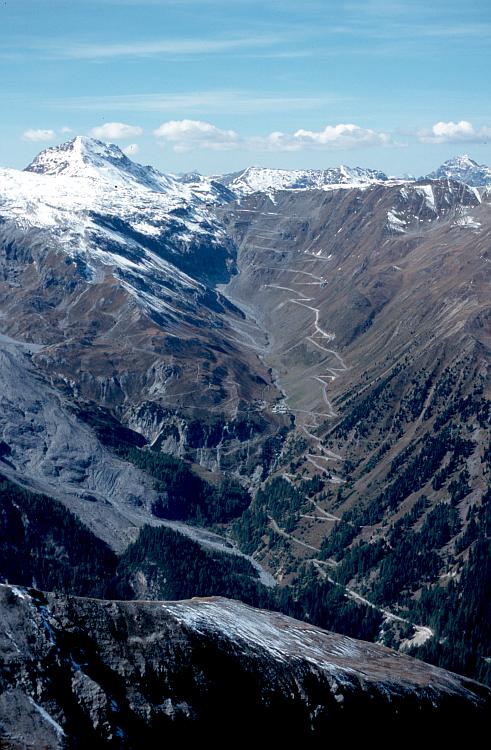
From Ortisei we struck out on route 242 west to the autostrada, hooking up with the A22 near Bolzano. We messed up (okay, perhaps I briefly neglected my navigation duties because I was slightly distracted by the amazing castle perched on a hill above the highway) and went too far south on the A22. We ended up going about 20 kilometers out of our way and wound up in a traffic jam and had to pay a toll before we could get off and turn around. Finally we got on track again and headed north back to Merano, the way we had come on Thursday. We took route 38 west through Naturno and Silandro, passing through a lovely valley lined with more espaliered apple trees bursting with fruit. At Spodigna, we continued on the 38 south towards the Stelvio Pass (#9, sign in Spodigna above), one of the most famous roads in the Alps. You can see a pretty amazing image of the pass from across the valley here: www.weltderberge.de/alpen/pics/bbe15649.jpg. At 2758 meters, the Paso dello Stelvio (Stilfserjoch in German) is the highest paved mountain pass in the Eastern Alps and the second highest paved pass in the Alps overall, second only to the Col de l’Iseran in France at 2770 meters.

Located about 75 kilometers west of Bolzano, very close to the Swiss border, one of the peaks above the Stelvio Pass is named Dreisprachenspitze, or "Three languages peak," because this is where the historically Italian, German and Romansch-speaking regions all come together. The original road was built by the Austrian Empire in the 1820s to connect the former Austrian province of Lombardia with the rest of Austria. The route has changed very little since then, comprising a grand total of 60 hairpin turns, 48 of which are on the northern side of the pass. The pass was strategically important during World War I, as it formed the border between the Austro-Hungarian Empire and Italy. A portion of Swiss territory jutted between Austria and Italy and the three nations had to reach an agreement not to fire over the Swiss area. Today, the pass is busy not with gunfire but tourists – it is generally open from June to September and has become a favorite route for motorists and motorcyclists, as well as a mecca for hard-core bicyclists.

As we approached the pass, the rolling forested hills gave little indication of the dramatic scenery that was about to unfold above us. Just below the bottom of the pass, we stopped at the side of the road for a pit stop. This was an unfortunate decision, as apparently many other travelers have had the same idea. Perhaps the locals should invest in a rest area for Stelvio Pass pilgrims. I would be happy to pay for the privilege of a clean bathroom. We took this opportunity to put the top down on the SLK, which ended up being a wise choice, as it is much easier to see out of a car with no roof.

I suppose if we had had a little more time to plan this trip, we might have considered the possibility that driving one of the most famous roads in Europe on a Saturday afternoon in August was perhaps not the most brilliant idea. As we started up the first few switchbacks, we realized that this was going to be more about avoiding the swarms of bicyclists, weaving motorcyclists, and monstrous slow-moving RVs and tour buses than it was about enjoying the drive. Unfortunately, the fame of the Stelvio Pass has reached far beyond motoring enthusiasts and it has now become an attraction even for those who have no idea how to drive. On the bright side, our slow pace allowed us (well, me, at least) to enjoy the dramatic view of snow-capped peaks that slowly revealed themselves above us.

We were about a quarter of the way up the pass, following a dark silver Audi A6, when a large bus suddenly bore down on us around a particularly tight hairpin turn. The Audi stopped dead in its tracks to let the bus swing around the bend, but that was still not enough room for the bus, and the Audi started backing up – without bothering to notice that we were a few feet behind him! John had to honk at the guy and I am pretty sure he only missed hitting us by a few inches. Another time, a guy on a big touring motorcycle could not make it around a turn and put his foot down, stopping right in front of us. Avoiding the bicyclists was the worst – they seem to think they own the road. I found myself craning my neck to look around each switchback to let John know if the way ahead was clear, so he wouldn’t have to worry if he swung out a little bit into the opposite lane.

We took a break about halfway up, near the ruins of a burnt-out hotel. We looked further up the pass and marveled at the engineering of the road, which is cantilevered out over the mountainside in places. Towards the top we found ourselves behind a guy in a pimped-out Ford Focus RS who didn’t seem to possess a very high degree of driving skill. We followed him into the parking lot at the summit of the pass, where he joined a group of his friends in Mitsubishi Evos and Subaru Impreza WRXs. We stopped again here to soak in the view, looking directly down on a long stretch of the road snaking up the mountainside (photos, above and right).

In a nutshell, the Stelvio Pass is far too narrow to be enjoyed in anything but the smallest of sportscars, and is basically too crowded to be enjoyed at all. Even the SLK felt huge as John lugged it around those tight hairpins. I would strongly advise against driving it on a summer weekend, and if you are going to make the trek to Stelvio, be sure to tour some of the other great passes in the region, which are lesser known but make for far better driving experiences (like the Jaufenpass, Sella Pass, and some of the others I will describe later).

Here is a movie clip that gives you a bit of an idea of what it's like to drive up the Stelvio Pass:


We ran a gauntlet of parked motorcycles at the top of the pass, an area thronged with hordes of bicyclists and tourists, all swarming around a cluster of hotels, restaurants, and souvenir shops. The crowds disappeared as we descended the other side, into a desolate expanse of jagged mountains. After a few kilometers we reached the turnoff for the Umbrailpass (#10, a.k.a. Giogo di Santa Maria), which was marked by a gate and sign (written only in Italian) that says the road is open from 6 in the morning until 10:00 at night. The Umbrail is one of the only unpaved mountain passes left in the Alps and, at 2500 meters, is the highest pass traversable by car in Switzerland. We crossed the Swiss border (marked only by a deserted customs station) just a few hundred meters down the road, then continued our descent through a barren valley on a challenging road with very few guardrails (photo, above). Apparently far fewer vehicles come down this side and we enjoyed it a lot more than the Stelvio. The road turned to gravel partway down, but it was only unpaved for a few kilometers, perhaps one-third of the total 13.4-kilometer stretch. We were followed by a Land Rover Defender most of the way down – he had no trouble keeping up with us in the gravel – but otherwise we saw more motorcycles than cars on the Umbrail.

We reached the postcard-perfect town of Santa Maria at the bottom of the Umbrail, where we turned left onto the Ofenpassstraße (only in German can one justify the use of the “triple-s”). This took us on a gorgeous route through the Val Müstair, a landscape of dry conifer forests and broad golden meadows that reminded us of western Montana. We stopped at a little restaurant at the top of the Ofenpass (#11, 2149 meters) to buy sodas and candy bars, then hiked a short ways up a rocky trail to sit on a bench, eat our snacks, and enjoy the view. I took the wheel at this point and drove down the other side of the Ofenpass. The road was perfect – long sweeping bends and minimal traffic. The route took us through a portion of the Swiss National Park (photo, right), home to Europe’s largest Hallimasch fungus (boasting an estimated diameter of 500-800 meters; don't you learn the darndest things on Wikipedia?). The road was dotted with trailheads and the area is obviously extremely popular for hiking. In July 2006, a brown bear was spotted in the park – the first wild bear sighting in Switzerland in over one hundred years. Hikers beware!

At Zernez we turned southwest and took route 27 along the River Inn to the lakeside resort of St. Moritz. We stopped for gas at a BP station that had pumps on both sides of the road. John pumped and paid for the gas while I crossed the street to the store to look for the restrooms. I couldn’t find them so I went inside and asked where the toilets were in German; the young woman at the cash register gave me a strange look and gestured vaguely outside. I circled the whole building but didn’t find a door that seemed to indicate the restroom. I went back inside and asked again. The woman asked me if I was a customer. I pointed to our car and said something that hopefully resembled “that’s our car on the other side of the street”). She pointed to the door and told me the restroom was the first door to the left outside. I went out again, and sure enough, the door was completely unmarked. Strange!

We had now entered the region of Switzerland known as the Engadin, which means “garden of the Inn” in the local Romansch language. We traversed the Oberengadin or Upper Engadin from Zernez to Maloja, an area marked by a chain of beautiful blue lakes dotted with sailboats and ringed by cheerful hotels. From here we descended the precipitous Malojapass (#12, 1815 meters), our final pass of the day, which would take us back into Italy. This was another very crowded road; we followed a string of cars and motorcycles down an impossibly steep series of switchbacks through thick conifer forest (photo, right). About 22 kilometers later and 1100 meters lower, we crossed into Italy at Castasegna. We noticed a pronounced shift in the local architecture that coincided dramatically with the elevation change: from the high mountains, where the hillsides were dotted with tidy Tirolean chalets with overhanging eaves and window boxes bursting with pink and red geraniums, to the lower valleys, where rambling stucco-walled, tile-roofed villas in warm pastel tones sprouted in haphazard clusters.

From Chiavenna, just inside the Italian border, it was only a short drive south to the shores of Lake Como, where the road suddenly became a busy four-lane highway. The lake was hidden from view most of the way along the eastern shore, as it passes through a series of long and slightly claustrophobic tunnels. Because Lake Como is a very long, narrow lake, we realized that we would have to go ridiculously far out of our way to reach Bellagio by land and it made far more sense to take the ferry from Varenna. We found the turnoff for Varenna and wound our way slowly down to the lakeshore, following the signs to the ferry. I managed to maneuver the car into what I assumed was the line for the ferry while John went off to scout out tickets. He returned triumphant with a ticket (11,60 Euro for the car and passengers) for the next departure, leaving in about twenty minutes. We walked around near the ferry dock while we waited. Varenna looked beautiful with its brightly-hued villas tumbling down the hill to the water’s edge (photo, right).

A ferry arrived a few minutes later and unloaded; we were about to drive onto it but the man taking the tickets kindly told us it was the wrong one (I think it was the ferry to Menaggio) and ours would be arriving a few minutes later. Finally we got on the right boat and boarded for the fifteen-minute ride across the lake. It was an incredible evening – only a few wisps of clouds in an otherwise brilliant blue sky, and we marveled at the views. I didn’t have a good image in my mind of Lake Como (other than ritzy villas and resorts, of which it boasts a fair few) before we arrived and I was somewhat surprised by the dramatic mountain slopes of the Parco delle Grigne rising sharply from the east side of the lake. But there was also more development than I expected – the lake is ringed by small towns and the hillsides are dotted with houses. Bellagio, however, was a pleasant surprise – much smaller than I imagined and, dare I say, a bit sleepy even on this gorgeous warm evening at the height of the tourist season. The hotels and houses of Bellagio glowed in a glorious array of gold, apricot, and pink tones as we approached the ferry dock.

Bellagio sits on a point of land that juts into the lake from the south and thus commands some of the most spectacular views in the area. We spotted our hotel, the Metropole, before we reached the dock, and I knew we were in for a treat (photo, above - the Metropole is the pink building to the right of the large white boat). The Metropole is located right on the waterfront and the balconies literally hang over the water (as opposed to some of the other lakefront hotels that have a street in front of them). We drove off the ferry and tried to find parking in a lot in town but it was totally full and, since it was dinnertime, we didn’t expect any spaces to open up soon. We drove a short ways down the road and found another lot with three cars in line waiting to get in. The guy at the gate waved me away but I stayed put and gave him the sweetest look of girlish anxiety that I could muster. A car left the lot a minute later and the man gestured that I could stay. He came up to my window and said something indecipherable in Italian, but switched to English in response to my blank expression. I told him I wanted to park overnight and he showed me to a spot. It cost 10 Euro, which we figured was fair. We unloaded our bags and hoofed it back to the hotel, which wasn’t too difficult because the SLK’s miniscule trunk (even smaller with the top down) has forced us to travel very light. We walked down a gorgeous flower-bedecked esplanade and I made John stop so I could take pictures as I knew this would be my one and only chance to capture the magical evening light (photo, right).

Our reception at the Metropole was polite if not overly friendly, and we climbed the stairs to our tiny double room on the first floor. The bed took up most of the space but the room was tidy and the gray tile bathroom was clean and serviceable. Our view was exactly as advertised – floor-to-ceiling french doors opening onto a tiny balcony with just enough room for two chairs (although ours had only one) and an absolutely stunning 180-degree view of the lake (photo, below, with a car ferry like the one we took from Varenna). Honestly, this was the bargain of our trip at 144 Euro. We arrived just in time to watch the sun disappear over the mountains to the west, casting long golden rays across the lake. Then we both showered and changed into our best “evening wear” (yes, I brought along my stylish black-and-white sundress especially for this occasion). We strolled along the waterfront looking at menus and decided that the Hotel Florence looked the most promising – it had the most interesting menu and the prettiest terrace overlooking the water, framed by a lovely trellis dripping with wisteria. We had to wait for a while for a table but the waiter we spoke to suggested that we have drinks at their bar across the street. We ordered gin & tonics and sat at a table outside, watching the lights come on across the lake.

We were seated at a table right on the water (the waiter sat us and another couple at the same time but he gave us the better table because we had been waiting longer) and enjoyed an absolutely lovely meal. John had risotto with smoked salmon and caviar followed by roast duck with mushrooms in a balsamic sauce. I started with fresh pasta strips with pesto, pine nuts, and zucchini flowers followed by carpaccio with smoked ricotta and shaved truffle. I don’t think I’ve ever had a plate of carpaccio I didn’t like, but this was a very nice twist on the classic. We asked one of our servers for a wine recommendation and he suggested a very nice Barbera red that had a whole long story associated with it (I think he knew the family or something – it may have all been made up, but he told the story with great enthusiasm!). For dessert we both had peach and white chocolate mousse with a milk-based sauce flavored with cognac and almond. We teetered back to the hotel (thank goodness it was only a few hundred yards away) and fell into bed.

More photos from today's drive:
http://www.flickr.com/photos/hausfrau/sets/72157602870675228/

Sunday, October 28, 2007

3 August: Mountain Majesty

We woke up to a steady drizzle and a valley obscured by clouds, which put a bit of a damper (pun intended) on our plans to take a scenic drive around the Sella Gruppe, one of the most famous mountain groups in the Dolomites. In no hurry to get out into the rain, we had a relaxing breakfast in the Uhrerhof’s breakfast room, feasting on the typical buffet of cold cuts and cheese, croissants and rolls with homemade jams, hard-boiled eggs, and canned fruits.

We decided to wait out the rain by driving down into Ortisei and doing a little shopping. We parked in a garage in the middle of town and came out in the midst of a lively street market. We made our way to the main shopping area and visited the town’s main church, the interior of which is a wonder of apricot and mint-green tones accented with gold gilt. Ortisei is famous for its woodcarving, and the town is crammed full of shops where you can buy carved items of every religious and secular theme imaginable – from crucifixes and crèches to wildlife sculptures and toys. We stopped at a nice little gift shop and bought two cow bells on leather straps. I am in the market for authentic alpine cow bells and haven’t found the “real thing” yet, but these were far better than the tacky fakes you find in most tourist shops. I’m also looking for a dirndl, or traditional alpine peasant dress, and we found a shop selling very stylish ones, but they were pricey and not colorful enough for our tastes. It was getting on towards lunch time so we stopped at a café for pizza and ciabatta while we waited for the sun to come out. The clouds were definitely breaking up and we finally got our first glimpse of the snow-capped peaks of the Sella Gruppe rising dramatically in the distance (photo, above).

We headed back to the parking garage but ended up waiting over twenty minutes to get out because some guy had gotten his ticket stuck in the machine at the exit gate. Someone must have called a phone number on the ticket machine because a man eventually showed up with some tools, looking very annoyed. He started prying open the machine and then suddenly threw his pliers on the ground and yelled “Impossible!” (you have to imagine it with the Italian accent, of course) three or four times, accompanied by violent hand gestures. He finally got the gate to go up but he was still standing there, fuming at the now-mangled machine, as we drove out. We left Ortisei around 2 p.m. and set our sights on the Sella Gruppe. More and more of the mountains slowly emerged out of the clouds as we pressed onwards and upwards through lush green valleys. We had chosen a counterclockwise route to take around the mountain group, heading first over the Passo di Sella (pass #5), which afforded us spectacular vistas around every curve (photo, above). John was driving and he reported that the SLK was a little gutless but handled the curves pretty well; we certainly wouldn’t want to drive those crazy narrow roads in a larger car! We stopped several times for photos; the SLK’s shiny black paint job looked particularly nice set against the pale limestone peaks (photo, right).

It took us an hour to get from Ortisei to the top of Passo di Pordoi (pass #6) where we geared up with hiking boots and our warmest clothes and bought tickets for the cable car ride (24 Euro round-trip) up to Sass Pordoi at a lofty 2,900 meters. The top was shrouded in clouds and we just hoped that we would be able to see something up there. We got some amazing views of the surrounding mountain landscape before our cable car was engulfed in a cloud as thick as pea soup. We walked out of the cable car terminal into a lunar landscape – nothing but jagged shards of rock as far as the eye could see. The remains of a recent snow clung to the ground and a biting wind chilled us to the bone. We took lots of photos (right) and then decided to follow the only obvious hiking trail, which took us past a small rifugio (a sort of “warming hut” like the hüttes of Switzerland and Germany, where you can buy snacks and drinks). The trail climbed slowly upwards as we traversed the side of a barren valley punctuated by dramatic dropoffs and watched a long line of hikers disappearing into the clouds on a ridge high above us. We think they must have been hiking up Piz Boè, the highest peak of the Sella Gruppe at 3,151 meters. We can only assume that they were going to spend the night up there, since they could not possibly get back down the mountain before dark.

As for us, we had no such ambitions and decided to veer off the trail to hike up to a stone cairn (see photo, right - the red dot marks the cairn), from which we looked out into the dramatic abyss on either side of the Pordoi Pass. The misty, swiftly-moving clouds broke up just enough for us to catch enticing glimpses of endless mountain ridges disappearing into the distance; we could only imagine how spectacular the view would be on a clear day! After taking our fill of photos, we retraced our route, stopping to admire the tiny yellow and white wildflowers that somehow manage to eek out a living in this harsh environment. We returned to the cable car terminal at 4:15, which gave us another half-hour to roam around before the second-to-last departure of the day. We found a natural arch in the rock and looked down through the hole at the crazy twists and turns of the Passo di Pordoi road. A huge metal-framed cross was erected near the cliff's edge and people have been slowly filling it with rocks.

Thank goodness for long summer days, as once we had returned to the bottom we had plenty of daylight left to continue our circumnavigation of the Sella Gruppe. Now it was my turn to drive, down the other side of the Passo di Pordoi and onwards over the Passo di Campolongo (#7) and Passo di Gardena (#8). We were amazed by the number of ski lifts and trams that dotted the slopes above us – this area must be absolutely amazing in the winter, but I’m not sure how you would decide where to ski, as there seem to be unlimited options available. It is impossible to describe the majesty of the Dolomites so you’ll just have to look at the pictures – I’ve posted more than 50 from today’s drive on Flickr (www.flickr.com/photos/hausfrau/sets/72157602761199541/). The driving was very challenging – lots of first-gear hairpin turns – but thrilling. We ran into some traffic towards the end as we headed back towards Ortisei, which slowed us down a bit. After stopping to admire the view over Ortisei - now brilliantly lit by the early evening sun - we returned to the hotel at 6:45, just in time for dinner, which is served promptly at 7:00.

Dinner was a repeat of the salad buffet followed by tomato & mozzarella salad, a simple chicken broth soup, a fabulous meat & cheese lasagne, classic Wienerschnitzel with creamy potatoes, and apple streudel with whipped cream, accompanied by another tasty Südtirol red wine. I think the Südtirol might just be my favorite place in Europe, as it seems to combine the best of Germany and Italy – dramatic landscapes, friendly people (who all speak German so I can actually communicate), and delicious food!

The only problem we had with the Hotel Uhrerhof is that we were seated in a dining room with two families whose kids could not keep still, so the atmosphere was somewhat less than romantic. I wonder why they didn’t seat us in other dining room, which was much quieter. We probably should have asked to move, but we always feel awkward complaining about such things. After our streudel we quickly retired to our room and enjoyed a nice brandy from the minibar as we planned out tomorrow’s route to Lake Como.

More photos from the Dolomites:
http://www.flickr.com/photos/hausfrau/sets/72157602761199541/

Saturday, October 27, 2007

2 August: Into the Dolomites

We had a minimal but adequate breakfast at Gasthof Badl of sliced cheese and ham, hard rolls, watery orange juice, and strong coffee. On our way out we had to maneuver around a large, elderly Bernese mountain dog who had commandeered a position at the top of the stairs. We checked out at 10 a.m. and left our car at the hotel while we explored Hall. We crossed over the river Inn on a covered wooden footbridge and found the town to be quite charming – very homey and non-touristy, the kind of place where everyone knows everyone else, centered around an irregularly-shaped market square (photo, right) with winding cobblestone streets lined with leaning houses. It was such a low-key place that I couldn’t even find a tourist shop to buy a souvenir magnet! We went inside the Pfarrkirche St. Nikolaus, the town’s largest church (also in photo, right), which has a unique off-center nave – it almost looks like they ran into some rocks when they were building the church and had to work around them. The interior is a mixture of gothic and baroque styles, with a heavily frescoed ceiling and a large collection of what look to be bishops’ crowns and skulls.

We returned to the car about an hour later by way of the main bridge, which gave us nice views of the town’s church spires (photo, right) and the landmark Münzeturm, or “coin tower” of the 14th-century Burg Hasegg, which housed Hall’s silver mint from 1477 to 1806. By 11:00 we were on the road again, heading west through Innsbruck, which is set against a dramatic backdrop of steep mountains. We headed south on route 182, which parallels the A13, through the Brennerpass (pass #3 of the trip – not too thrilling as far as driving goes, but more scenic than slogging up the Autobahn with all of its truck traffic).

We crossed into the Südtirol region of Italy at the town of Brenner. The landscape was still very Tirolean in character but now all of the signs (including the town names) were in Italian, German, and sometimes a third local dialect. At Sterzing / Vipiteno we headed southeast on route 44 through the Jaufenpass (pass #4), our first really famous route on the trip, which traverses some 40 kilometers through thick forest and golden grassy slopes to a height of 2,094 meters. The driving was great (although the road was quite narrow!), the weather was beautiful (we had the top down on the SLK), and we enjoyed gorgeous views of Tirolean chalets and dramatic barren peaks on all sides. We stopped part-way up to admire the views and I made friends with a Swiss cow (I call all of the mousey-brown cows with the big fuzzy ears “Swiss” cows, even if we aren’t in Switzerland), who moseyed up the hill to check us out. We stopped again at the top of the pass and climbed a short way up a rocky hillside to a stone cairn for an awesome 360-degree view (photo, right). We had a snack of country bread topped with cheese and tomato slices at the Edelweisshütte, obviously a popular stopping point for the throngs of motorcyclists out for a summer ride.

We were getting baked by the summer sun so we put the SLK’s top up on the way down the other side of the pass. There was a lot of traffic coming down and we had to navigate some pretty hairy turns marked by signs that read “kehr tornante” which I think means “caution hairpin turn”. At the lovely resort town of St. Leonard we headed south through the Passeiertal to Merano. Just before Merano the landscape took on a spectactular transformation – imagine Tirolean chalets and conifer forests colliding with Renaissance villas, espaliered apple orchards, and neatly tended vineyards! We were stuck on the streets of Merano for a while due to a car accident, so we had some time to admire this very pretty Mediterranean-influenced city. The Palace Hotel, surrounded by lush gardens, looked particularly inviting.

We continued south on the Autostrade (A38) to Bolzano, a mid-sized city whose biggest claim to fame is Ötzi, the 5,000-year-old mummified “Iceman.” We didn’t stop to visit him, as we needed to press onwards to our destination for the next two nights: Sankt Ulrich / Ortisei in the Dolomites. We went a bit too far north on the A22 because we couldn’t find an exit for the A12, and had to turn around at Klausen / Chiusa, but we got to see an amazing sprawling castle perched on top of a hill in the middle of the valley (photo, right). (I still haven’t properly identified this place, but it definitely looks worth visiting!) We ended up on route 242d instead of 242, so we got a little confused on our way to Sankt Ulrich / Ortisei, but we eventually found our way into the famed Val Gardena, where we got our first hazy glimpses of the craggy peaks of the Dolomites off in the distance.

Ortisei (that’s the Italian version) is a good-sized resort town nestled in a broad green valley surrounded by dramatic peaks. We head up a side valley to the village of Kastelruth / Castelrotto, which I wanted to see because lots of people seem to prefer it to Ortisei. It looked pleasant enough, although the surrounding landscape was not quite as spectacular as Ortisei. We headed up a narrow, winding road just outside of Ortisei to the tiny hamlet of Pufels and the idyllic Hotel Uhrerhof. This place was pure magic – it was so quiet in the narrow valley that you could hear the wind whispering in the trees and the faint tinkling of sheep bells floating up from the green meadows below the hotel. We were greeted by the lady of the house, Frau Zemmer, who speaks fluent Italian, German and English. Our room (#101) was huge and by far the nicest room we’ve had on the continent. It was all done in traditional Tirolean light wood, complete with a tiny wood-burning stove, a gorgeous modern bathroom stuffed with luxurious amenities, fluffy robes, chocolates on the pillows, and a large flower-fringed balcony with an incredible view across the valley and down into Ortisei (photo, right). I was already in love with this region and we’d only just arrived!

I sat out on our balcony for a while, soaking it all in and writing in my journal, and listened to the church bells in Pufels chime 6:00. We had reserved half-board at the Uhrerhof to avoid driving down into town for dinner. We enjoyed a five-course meal in the quaint, cozy dining room, which reminded us of the Maiensee in Austria. We partook of the ample salad buffet, followed by smoked goose with cabbage salad, puff pastry “pizza” smothered in cheese, mushrooms, and tomato sauce, tender veal with green beans and steamed potatoes, and a simple fruit cocktail for dessert. To drink we had a Südtirol Blauburgunder, which is similar to Pinot Noir. The food was traditional home cooking, nothing too fancy, but quite tasty.

A storm moved in this evening and we had heavy rain overnight – we just hope it clears up by tomorrow!

More photos from today:
http://www.flickr.com/photos/hausfrau/sets/72157602758287632/

Monday, September 3, 2007

17 June: Arrivederci, Bella Roma!

We rolled out of bed around 8:15, had breakfast, and went out to get some cash at the ATM to pay our hotel bill. I wanted to take a final look at the art vendors in Piazza Navona but didn’t see anything that called to me. Paolo was there again so we went over to say hi; Mom got his card because she wanted to remember his name. We went back to the hotel to check out and had a nice chat with one of the men who works at the front desk. We suggested that our room could use a mirror over the dressing table; this would have made it easier for us both to get ready to go out. We also mentioned that Mom could have used some help with her suitcase when we arrived. We were very friendly and polite about both issues and the man was really nice about it, apologizing for the suitcase oversight and telling us that he would pass the mirror suggestion on to the owners. I told him that I would give them a glowing review on Trip Advisor.

We left our luggage at the hotel and decided to spend our morning back at the bookstore near Largo di Torre Argentina, looking for books about Roman history, but finally decided to do some more research before buying anything. Mom bought a couple of books for the flight home, including one about expats living in Rome.

We walked over to Giolitti, which Elizabeth had told us was the best gelateria in Rome, and splurged on four flavors each. (Actually we bought medium-sized cups only to discover that they were pathetically small; we went back to the cashier and upgraded to the large size!) Mom had green melon, pink grapefruit, raspberry, and lemon and I had pink grapefruit, cantaloupe, peach, and limoncello. It was refreshing and delicious; pink grapefruit wins the prize!

I bought my requisite tacky Rome magnet near the Pantheon. For the last time, we passed the huge, bowl-shaped fountain that had been our guiding landmark every night on our way back to our hotel. We retrieved our luggage from the reception and rearranged our things while waiting for our driver to arrive. He came promptly at 2 p.m. and drove us to the airport in style in a silver Mercedes E-Class. We took a different route out of the city than before, passing right in front of St. Peter’s. We grabbed a quick snack at the airport and bought some pasta, porcini, salami, and parmesan as a treat for John before boarding our flight home to Stuttgart.

I feel so incredibly lucky to have seen Rome twice in one year. My previous two visits have been in December, so I was thrilled to see Rome in the summertime as I have often imagined it: warm-hued stucco baking in the hot sun under brilliant blue skies, ancient stone walls overflowing with brilliant fuschia bouganvilla vines, grand piazzas crammed with artists and performers, long warm nights spent basking in the golden glow of dancing fountains…it was everything I had imagined, and more. I am not a lover of big cities, but I find Rome’s vivid mix of ancient history and modern vibrancy totally, completely intoxicating. I am in love with this city, and I will be back!

16 June: Underground Rome

We were up at 7:30 and out the door by 9:30 to make sure we arrived on time at our Context: Rome tour meeting point near the Spanish Steps. (We never actually got to the Spanish Steps on this trip, but since the frenetic Piazza di Spagna area with its high-end designer boutiques and throngs of tourists is perhaps my least-favorite area of Rome, we were not overly disappointed.) Before leaving the hotel I made arrangements for our transportation back to the airport tomorrow afternoon. I think this was the sixth staff member I had spoken to at Residenza Canali and her English was not as strong as the rest, so I was a little nervous about whether we had communicated our departure time adequately. We decided to confirm again when we returned in the evening, just to be on the safe side.

I had surprised Mom with tickets for Context: Rome’s “Underground Rome: The Hidden City” tour for her birthday. I have never booked a tour for anything in my life, so I did this with some trepidation, but I read great reviews of Context: Rome and I was really hoping that we would get to see some unusual places that the ordinary tourist wouldn’t normally happen upon. Originally I was planning to book the "Layers of Rome" tour that included the Domus Aurea, Nero’s palace, but unfortunately this site has been closed to the public once again and the tour was taken off of Context’s schedule a couple of months ago. Thus I booked “The Hidden City” instead, which sounded interesting – including a visit to an ancient Roman apartment building.

We arrived at the meeting point in front of the church of San Lorenzo in Lucina about ten minutes early. Our guide, Elizabeth, an Austrian expert in Classical history married to an Italian man, arrived a few minutes later. We found her to be friendly and well-informed, and she spoke the most wonderful Austrian-and-Italian-accented English. We were joined by another mother-daughter duo and a mother and her teenage son, Jake (whom I liked immediately because he used his keychain flashlight to look into every nook and cranny). One of the things I like about Context is that they limit their groups to six people, so you don’t feel like you are part of some obnoxious horde following a guide yelling at the top of their lungs (or worse, using a loudspeaker) just to be heard.

With our group assembled, we entered San Lorenzo in Lucina, walked to the back of the church, down a corridor to a room displaying pottery and glass artifacts found at the site, and paid a 2 Euro donation to gain entry to the extensive ruins beneath the church. We entered via a short flight of stairs leading through a stone archway and found ourselves in a veritable maze of rooms. First we looked down into a dug-out pit where we could see the painted wall tiles from a 2nd-century building. Nearby, two rooms had been excavated to reveal extensive black-and-white mosaic tile floors (see photo). Several long corridors connected a series of rooms that had once constituted a 4th-century apartment building. We also visited a large domed room that was the site of the original 5th-century basilica, complete with a stone foundation where the ceremonial bath had stood. Elizabeth pointed out where columns and chunks of stone had been reused to make the foundation of the modern church. Jake used his flashlight to peer through a chink in the wall into an unexcavated room full of rubble (we joked that it looked to contain “ancient Roman trash”). There were signs of ongoing archaeological work everywhere – tags hanging off stones in the walls, crates crammed with ceramic shards – but Elizabeth told us that many Roman excavation projects are plagued by lack of funds, so the work usually happens in fits and starts, with long gaps in between.

Back outside, Elizabeth used a map to show us that we were standing on what used to be the broad plain of the Campus Martius, where the ancient Romans grazed cattle and carried out military drills. Elizabeth pointed out the original location of the Ara Pacis, the Arch of Peace, built by Augustus to commemorate his victories in Gaul and Hispania (John and I visited the reconstructed, intricately carved marble arch in its new, modern museum back in December) and, nearby, the spot where a towering Egyptian obelisk once stood. August had the obelisk erected as the focal point of a massive sundial; each year on his birthday, September 23rd (the fall equinox), the shadow of the obelisk would cut directly through the Ara Pacis, demonstrating that Augustus was clearly destined to be the bringer of peace to Rome. The obelisk was rediscovered after many centuries and now stands in front of the Palazzo Montecitorio, the seat of the Italian Chamber of Deputies.

Near the Pantheon we stopped to look at the crumbling remains of an immense, curved brick wall that was once part of the Baths of Agrippa. Over the centuries, houses have been built over, around, and literally through this ancient structure. I assume the interior rooms of those houses have curious curving walls, following the lines of the original building, although the brick has probably long since been plastered over.

Our next stop was the Crypta Balbi museum, which opened in 2000 as the newest addition to the National Museum of Rome. The site was discovered during construction work in 1981 and the new museum houses the remains of a crypta, an enclosed portico and large rectangular courtyard, which stood behind the stage of the Theater of Lucius Cornelius Balbus (one of Augustus’ generals). It was the smallest of three theaters in the vicinity, the others being the Theater of Pompey and the Theater of Marcellus. In Augustus’ time, the crypta was a place to relax and socialize during intermissions and between theater productions. Over the centuries, the theater and adjoining crypta fell into ruin, to be replaced by markets, warehouses, churches, homes, shops, and factories. Today it is very difficult to visualize the scale of the ancient Roman structures, but the museum does an excellent job of bringing the past to life through a series of schematics that show the theater in its heyday, and then how the site likely decayed and evolved over the ensuing centuries.

We had an 11:45 appointment to descend underground into the vast ruins beneath the modern museum. Elizabeth first showed us a section of exposed wall in which you can see fragments of the orginal marble-faced portico topped by centuries of medieval construction, including bits of Renaissance-era clay drain pipes – in all, more than twenty centuries of Roman history written in the stones. As we continued deeper underground, we passed through various chambers cluttered with chunks of columns and even the cobbles of an ancient Roman road.

At noon we had the unique opportunity to visit an active archaeological site hidden behind the museum. Elizabeth explained that we were lucky to be in the right place at the right time, as this was not part of the normal tour. We exited the museum via a back door and stepped out into an open area surrounded on all sides by a jumble of houses and the curious cantilevered tower of Santa Caterina dei Funari. We traversed the site on a covered metal walkway, peering down into various excavation pits, and descended a flight of stairs to enter the exedra, a large half-moon shaped, domed structure that stood at the opposite end of the portico from the theater (see photo, right). This particular structure was later turned into a public bathhouse, and a few sections of the curved bank of toilets have been reconstructed. We descended further into the rooms of an ancient villa, complete with marble and mosaic tile floors and a few surviving columns. At the end of a stone passage we found a temple to Mithras, an early-Christian era religious cult. The experience was spell-binding and, while the whole tour was worthwhile, this “behind the scenes” visit was the icing on the cake!

We left the Crypta Balbi and walked across the street to Largo di Torre Argentina, where Elizabeth explained the context of the four Republican-era temples and pointed out the area where Julius Caesar is believed to have been assassinated (outside the Theater of Pompey, the ruins of which are under buildings across the street). Mussolini had the Argentina ruins preserved, the story goes, because he wanted to emulate Augustus as the new “bringer of peace” to Rome.

At this point our tour came to an end. We thanked Elizabeth profusely, then Mom and I went across the street to a large bookstore that Elizabeth had recommended, where we each bought a copy of a book on ancient Roman monuments with reconstruction overlays (bigger and better than the small one I had purchased at the Colosseum).

It was now about 1:00 and we decided to wander back through the Jewish Ghetto (photo, right), where we had lunch at Da Giggetto, right next to the Porto d’Ottavia. We ate outside under an umbrella and had a fabulous meal despite the fact that it was oppressively hot and breezeless. We shared a half-liter of white wine and a simple caprese salad – a huge ball of mozzarella and juicy slices of tomato, just about perfect with a drizzle of olive oil and a dusting of black pepper. I had the house special cannelloni (spicy pork filling, delicious tomato sauce and rich béchamel) and Mom had the classic spaghetti alla carbonara (raw egg, pancetta, and parmesan); both were excellent. Our waiter was very friendly and funny – he seemed to know exactly what we were going to order before we ordered it, and when I asked him to take a picture of us with Mom’s camera, he turned it around and snapped a picture of himself first!

After lunch we crossed the Ponte Fabricio for the second time (beautifully framed by green leaves in the afternoon sun) back to Tiber Island, where we stopped for a few minutes to watch a group of Italians arriving for a wedding at the church of San Bartolomeo all’Isola. It was a scene straight out of a movie – the women dressed to the nines in chic black or navy with strappy stiletto-heeled sandals, the men in black suits driving expensive Italian and German sedans, and the children in frilly white dresses and patent-leather shoes.

We meandered our way back to Trastevere, which was tranquil and quiet, apparently enjoying an afternoon siesta. We stopped to take pictures of a particularly lovely tangerine-colored villa (right), whereupon not one but two older gentlemen stopped to smile and jabber at us in Italian. We had no idea what they were saying but they seemed to be pleased that we were taking a picture of this particular building. We smiled back and I took a picture of the plaque mounted on the building to try to translate later, assuming it meant something important happened there. (Postscript: Well, the plaque just seems to prohibit the throwing of something – rubbish? – in the street, so this little mystery remains unsolved!)

A little further down the street, two young men came around the corner carrying those huge super-soaker squirt guns that kids like to play with on hot summer days. We immediately held our arms out and I shouted, “Prego!” whereupon the men grinned and cheerfully obliged by spraying us with water.

We found the bead shop that we had visited on Friday; Mom had told the proprietor that we would come back but I’m sure he didn’t believe us. Mom bought some flower beads that she was coveting and I found some things I needed to finish my necklaces. The nice man gave me some crimp beads for free (carefully laying them on a bit of tape so I wouldn't lose them) and asked me about my photography (since I had my Canon digital SLR around my neck). On our way back we stopped for gelato in Piazza di Santa Maria in Trastevere because we realized that we had been in Rome for three sweltering days without a single gelato! I had coffee and dark chocolate and Mom had lemon and sour cherry. We sat at a table inside (the outside tables were full and it was refreshingly cool inside) and watched as yet another wedding party came tumbling out of the church across the square; half of the guests then seemed to descend on our gelateria! Best of all, we were served real ice water with our gelato and got to use the restroom.

We retraced our steps back to Tiber Island and the Ghetto and arrived back at our hotel with an entire hour to clean up before our dinner reservation at Il Bacaro. I dressed up for the occasion in my recently purchased black-and-white cotton sundress (all the rage in Rome). We were the first guests to be seated outside under the lovely vine-covered arbor. We perused the refreshingly innovative menu and ordered an excellent Pinot Grigio riserva. Mom had smoked goose carpaccio with paper-thin slices of white peach drizzled with olive oil, followed by veal cutlets with an incredible pink grapefruit sauce, and pistachio ice cream with strawberry sauce for dessert. We decided hers was the prize-winning meal of the whole trip – everything was perfectly fresh, gorgeous, and delicious. My meal started out on a bright note with a warm calamari salad with delicate lemon-mint pesto. I thought I would be healthy and ordered the swordfish roulades with shrimp, zucchini and radicchio in a soy-balsamic glaze, but the fish was downright fishy and too salty. I came very close to complaining, but for whatever reason decided to grin and bear it. My dessert redeemed my entrée (what was that about being healthy?) – rich chocolate mousse with even richer chocolate sauce, which was absolutely heavenly! Our three-course meal, including a 25 Euro bottle of wine, came to a very reasonable 100 Euro. Despite my disappointing entrée, I would highly recommend this place.

We thought we might actually get back to our hotel a little early for once (it was about 9:30) but we ended up delving into a lengthy conversation with the couple sitting next to us – an Irish woman and French man. We traded stories about Rome and our other travel experiences for a good half-hour before finally tearing ourselves away. I dragged Mom to the Trevi Fountain, which was of course totally mobbed with tourists from across the globe. We took some pictures and tossed a 1 Euro coin into the fountain together (assuring our return to the Eternal City) and then walked slowly back to the hotel, savoring every moment of our last night in Rome.