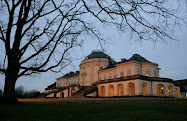
We awoke to a rather cloudy, dreary morning – not the best sort of weather for castle viewing, but we couldn’t complain because we had had great weather so far (for late October) with no rain.

We realized that we could see all the way to Burg Pfalz, the famous island castle in the middle of the
Rhine, from our window.
We had breakfast in a different dining room at the Schönburg, furnished with cozy bench seats under the windows, and were served our food at our table as opposed to the traditional buffet.
They brought us a multi-tiered serving tray loaded with different kinds of meats, cheeses, and smoked and pickled fish.
After breakfast we decided to do a little castle exploring. John is always a little leery when I get in the mood to venture down dark passageways and open unmarked doors, but this time we found our way out onto the ruined stone walls of the castle’s outer fortifications and were rewarded with an incredible panoramic view of the castle and surrounding countryside (photo, right). We rambled about on top of the walls for a bit and then John scoped out a long, dark staircase built directly into the wall, but the door at the bottom was locked. Back on the ground, we explored some of the other public rooms of the castle, including the library and the prison tower, which has been converted into a cozy dining nook, then circled around to the other side of the castle to take in the view over the town of Oberwesel, dominated by the red stone Liebfrauenkirche. We didn’t have time to explore the town but it looked like an interesting place, with a number of its defensive towers and walls still intact.
With great reluctance, we packed up our things had our luggage taken down to the car, and said farewell to the Schönburg. We had all day to get back to Stuttgart so we decided to do an “up-and-down” tour of the Mittelrhein, with a stop at Marksburg, the only land-based castle on the Rhine to have survived the centuries virtually intact. We headed north on the west side of the river, literally ticking off castles as we went along. You cannot drive for more than about five minutes on either side of the Rhine without spotting a castle. While the landscape and vineyards may not be as dramatic as the Mosel (the Rhine valley is wider and marred by railroad tracks up and down its length), you can’t beat the Rhine for its pure density of castles, thus it automatically makes my list as one of the most spectacular areas we’ve visited in Germany. In most cases we had the best views of the castles on the opposite side of the river, so I will describe them in that order.
 Just north of Oberwesel we passed the famous cliff of Loreley, a 430-foot-high outcropping of dark slate named for the beautiful blonde nymph who lured sailors and fishermen to their deaths in the treacherous rapids below. At the well-fortified town of St. Goar, we could see across the river to the two 14th-century castles perched above St. Goarshausen whose names, Burg Katz (photo, right) and Burg Maus, are reflective of the numerous power struggles that plagued the region during the Middle Ages. In response to the construction of Burg Rheinfels at St. Goar, the archbishop of Trier constructed a small castle just north of St. Goarshausen. In turn, the masters of Rheinfels, the counts of Katzenelnbogen, built a bigger castle directly above St. Goarshausen, no more than a quarter-mile away. Its name was shortened to Burg Katz, and its lesser neighbor was mockingly referred to as Burg Maus.
Just a few miles further north, near the town of Boppard on the west side of the river and Kamp-Bornhofen on the east, we came upon the castles of Liebenstein and Sterrenberg, known as the Feindliche Brüder (rival brothers). The two imposing structures are mere yards apart, separated by a stone “quarrel wall.” Legend has it that two brothers inhabited the castles and feuded over a shared love. Sterrenberg is the oldest preserved castle on the Rhine, first mentioned in 1034, while Liebenstein was not constructed until the 13th century, but it is not know for what purpose – defense or to lay siege to Sterrenberg.
 A few miles further on, we stopped along a wide bend in the river to watch a container barge chug past and to take some pictures of the E-Class in yet another spectacular setting (photo, right; by this point we should have enough photos for an entire “E-Class in Europe” calendar). We had to drive a few miles past Marksburg in order to reach a point where we could cross the Rhine. We crossed on a bridge just north of Lahnstein, where Burg Lahneck was constructed in 1226 by the Archbishop of Mainz and Prince Elector Siegfried of Eppenstein to protect their territory at the mouth of the River Lahn. We backtracked south again for a few miles to the town of Braubach, which is dominated by the cream-and-orange lookout tower of Marksburg. We headed up a narrow winding road to a parking lot just below the castle, climbed a steep trail to the main entrance, and purchased tickets for an English tour.
Marksburg was built in the 12th century to protect the silver and lead mines in the area and, as I mentioned previously, is the only Rhine castle that has never been destroyed. Our very friendly, elderly guide used a giant key to let us in through the massive gate and we proceeded up a roughly-paved road to the castle proper.  On the outer battlements we got a look at some early cannons, took a good sniff of the medieval herb garden, and enjoyed the panoramic view of the Rhine valley (photo, right) before heading inside. We started at the bottom with the wine cellar, dominated by a row of enormous wine barrels and a huge wine press. Next stop was the kitchen, equipped with a cavernous fireplace, an extensive collection of pewter dishes, and a long trestle table. The living areas featured dark wood paneling, brightly painted murals, and cozy bench seats built into the walls next to the windows to take advantage of the natural light. After wandering through several twisting passages, we arrived at a roomful of mannequin knights outfitted in suits of armor (some replicas and some real) spanning some sixteen centuries of European history. Back outside, we returned to the outer walls and examined a reenactment of a blacksmith’s shop, complete with enormous bellows and anvil at the ready. The tour seemed to take in only a tiny fraction of the castle, but provided a fascinating glimpse into medieval life and architecture.
After our tour we checked out the gift shop and were going to drop in at the restaurant for a bite to eat, but the place looked totally deserted, so we decided to get underway again. We stopped at the base of the castle for some more pictures (photo, right) and then continued south, now on the east side of the river. We got a better view of the good-sized resort town of Boppard from this side, and were able to stop and get a decent shot of Burg Maus (the Rhine highways are somewhat lacking in pullouts for photo fanatics like me). At St. Goarhausen, we were finally able to see what we had only glimpsed as we drove through St. Goar earlier: the immense, sprawling ruins of Burg Rheinfels (photo, below). First established in 1245, the fortress was repeatedly expanded by the counts of Katzenelnbogen and their successors, the landgraves of Hesse, making St. Goar the best-fortified town in the Mittelrhein. The castle was ultimately destroyed by the French in 1797, but retains plenty of atmosphere. This place definitely merits a future visit!
A few miles further on we got a nice view of Schönburg towering over Oberwesel, then we continued up the river to Kaub and Burg Pfalz. At first we were only going to stop for a quick picture, but then we saw the waiting boat and decided to go ahead and check out the castle. For a few Euro we were ferried across to the island along with a German family with two young children. From the island we had a good view of Burg Gutenfels above Kaub and could see back down the river to Schönburg and Oberwesel.
Burg Pfalzgrafenstein – shortened to Pfalz – is a unique six-sided, six-story tower built on a rocky outcropping in the middle of the Rhine. Built by King Ludwig I in 1326 to collect customs duties from vessels operating on the river, the castle resembles nothing so much as a giant stone ship, with its upstream defensive wall serving as the prow. The castle’s bold orange-and-white color scheme is Baroque, as is the elegant cap of the tower. A chain across the river forced ships to stop and pay customs duties, and uncooperative merchants were kept in the dungeon until ransom was paid. Like Marksburg, the Pfalz was never destroyed and has withstood not only battles, but natural threats in the form of floods and ice floes.
 We walked up a steep flight of stairs to the castle’s imposing entry gate (photo, right) and paid our admission to a couple of guys hanging out in a cozy room tucked inside the castle walls. They joked with us a bit and gave us a much-abused laminated guide to the castle, then we proceeded on our self-guided tour.
Unlike many restored castles, the Pfalz, which quartered about twenty men at any given time, reflects the living conditions of the 14th century and is furnished very simply with a smattering of household goods. One of the most interesting tidbits gleaned from our handout was that one of the masters of the castle was excommunicated by the Pope for collecting illegal tolls on the river. In the winter of 1814, the island was used by 60,000 Prussian troops led by Blücher to cross the Rhine in their pursuit of Napoleon. The castle was acquired by Prussia in 1866, whereupon toll collections ceased. It was used as a signal station for river boat traffic well into the mid-20th century, and then became the property of the State of Rheinland-Pfalz.
Inside, we explored several floors of the castle, including the well-fortified defensive walls armed with cannons, several strategically placed gun ports, and the officers’ living quarters. In the center of the castle there is an enormous clay bread oven, which is apparently quite a rare specimen. We discovered the rather spartan lavatory as well as the dungeon, into which unfortunate prisoners were lowered by means of a piece of wood tied to a rope.
After completing our tour of the interior, we made a complete circle around the castle, admiring its oddly elegant structure (photo, right). The foundations are marked with the highwater marks from various floods – the highest being from 1988. A gilded lion holding a sword and shield adorns the “prow” of the castle; during one particularly harsh winter, the ice flows on the river came up to the lion (easily 25 feet above the current river level) and wrenched the sword right out of its paws.
It was late afternoon by the time we took the boat back over to the mainland and continued on our journey south. We spotted two of three castles near Trechtingshausen, both perched on rocky outcroppings overlooking the river: the sprawling Burg Reichenstein and the rather quaint (by comparison) Burg Rheinstein. The latter was the home of Rudolf von Habsburg from 1282 to 1286, who destroyed the castles of Reichenstein and nearby Sooneck and had their robber barons hanged in an effort to restore law and order on the Rhine. All three of the castles are open to the public and house valuable collections of furniture, weapons, and art.
The final checkmark on our list of Rhine castle sightings went to the Mäuseturm (Mice Tower) near Bingen, a tall, narrow watchtower and toll station built by the archbishops of Mainz in the 13th century. The name comes from a grisly legend recounted in our Fodor’s guidebook: “During a famine in 969, the miserly Archbishop Hatto hoarded grain and sought refuge in the tower to escape the peasants’ pleas for food. The stockpile attracted scads of mice to the tower, where they devoured everything in sight, including Hatto.” Since the tower wasn’t actually built until several hundred years later, this legend apparently doesn’t hold water (no river-related pun intended).
From Bingen we hooked up with the A61 and high-tailed it home to Stutgart, bringing to a close our last great Germany-based European adventure.
More photos from today:
http://www.flickr.com/photos/hausfrau/sets/72157604099509243/
 We realized that we could see all the way to Burg Pfalz, the famous island castle in the middle of the
  Just north of Oberwesel we passed the famous cliff of Loreley, a 430-foot-high outcropping of dark slate named for the beautiful blonde nymph who lured sailors and fishermen to their deaths in the treacherous rapids below. At the well-fortified town of
  A few miles further on, we stopped along a wide bend in the river to watch a container barge chug past and to take some pictures of the E-Class in yet another spectacular setting (photo, right; by this point we should have enough photos for an entire “E-Class in
  On the outer battlements we got a look at some early cannons, took a good sniff of the medieval herb garden, and enjoyed the panoramic view of the